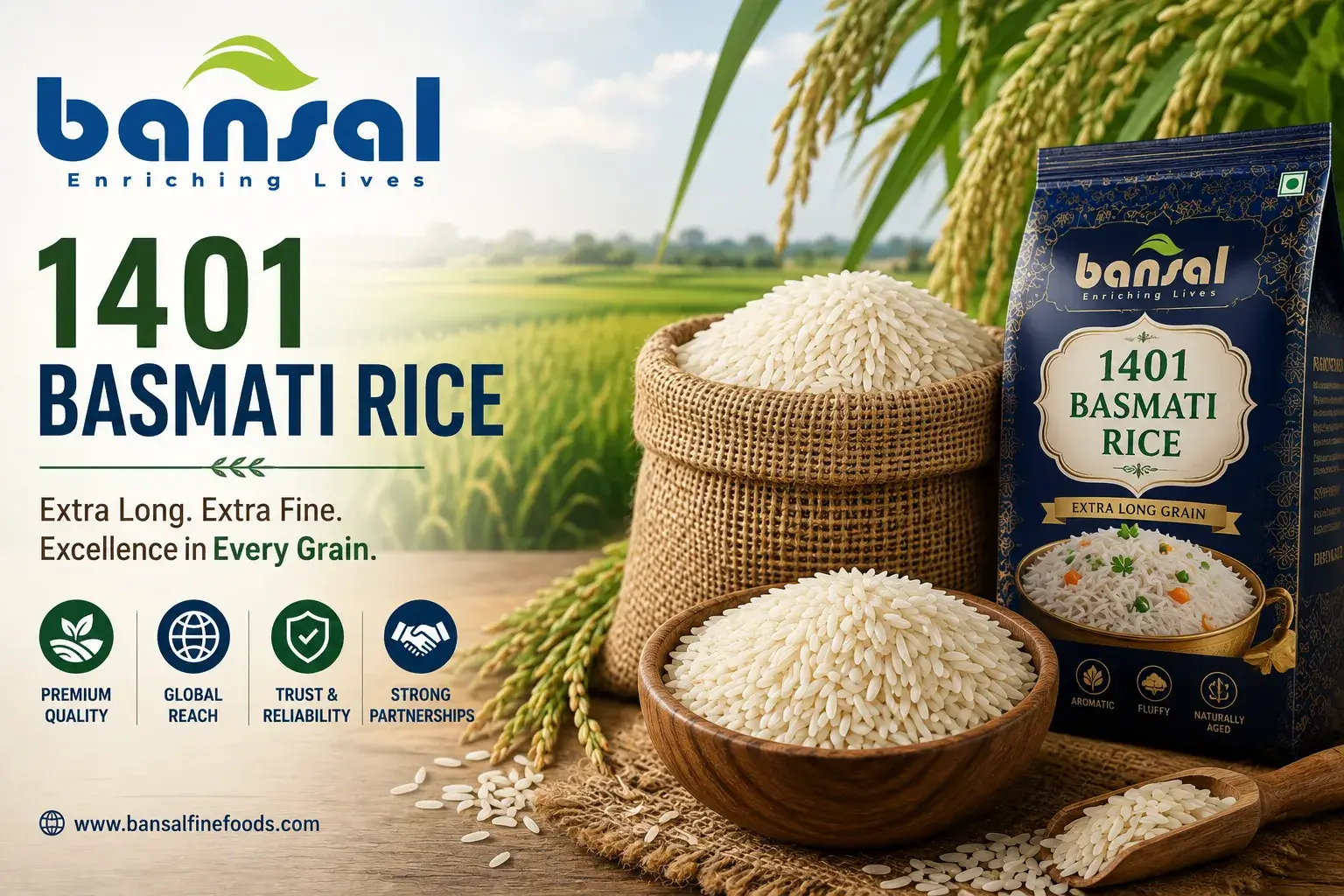
Not every buyer is chasing the longest possible grain or the most dramatic elongation. For a large segment of international importers — particularly in Europe, where regulatory compliance is as important as taste — consistency, shelf life, and residue compliance often matter more than headline grain length. That’s where 1401 basmati rice has quietly built a loyal following.
At Bansal FineFoods, 1401 sits alongside 1121, 1509, 1718, and our Pusa and Traditional basmati lines within our basmati rice exporter and supplier portfolio. This post covers what makes 1401 a dependable choice for buyers who need predictable quality shipment after shipment.
What Is 1401 Basmati Rice?
1401 is a basmati variety known for producing long, slender grains with strong post-cooking elongation and a comparatively soft, non-sticky texture. While its raw grain length runs slightly shorter than 1121, it more than compensates with structural consistency — grains hold their shape well through milling, storage, and cooking, with less tendency to break during processing.
It’s a variety that has earned its reputation less through marketing and more through repeat orders: buyers who try 1401 for a single shipment often come back for it specifically because it performs the same way, batch after batch.
Key Characteristics of 1401 Basmati Rice
Grain elongation — 1401 elongates well when cooked, producing long, distinct grains without excessive swelling, giving it good plate presentation for both home and commercial cooking.
Texture and shelf life — one of 1401’s standout qualities is that it stays non-sticky after cooking and holds up well over time, which matters enormously for buyers supplying ready-meal producers, catering operations, or retail packs that sit on shelves for extended periods.
Aroma — a balanced, moderate basmati fragrance — present and recognizable, without being as intense as 1121, which some markets actually prefer for versatility across different cuisines.
Pesticide residue compliance — this is where 1401 has built much of its export reputation. It has a strong track record of passing strict Maximum Residue Limit (MRL) testing, which is a significant factor for buyers shipping into the European Union, where residue standards are among the tightest in the world.
Nutritional profile — like other basmati varieties, 1401 carries antioxidant properties and a favorable nutritional profile, a detail that increasingly matters to health-conscious retail buyers and private-label brands positioning products around clean sourcing.
Why European and Institutional Buyers Prefer 1401
Ask an importer who regularly ships into the EU why they favor 1401, and the answer usually comes down to risk management. Every basmati shipment into a regulated market carries the possibility of residue testing at the port of entry — and a failed test can mean a rejected container, reputational damage, and significant financial loss. Varieties with a strong, consistent MRL compliance track record reduce that risk considerably, which is exactly why 1401 has become a go-to choice for buyers who can’t afford surprises.
The same logic applies to institutional buyers — hotel groups, catering companies, food service distributors — who need rice that behaves the same way whether it’s being cooked in a 10-kilogram batch or a 500-kilogram batch. 1401’s structural consistency makes portion planning and recipe standardization considerably easier at scale.
Common Applications for 1401 Basmati Rice
- Bulk institutional supply — hospitals, catering companies, and large kitchens value its predictable cooking behavior
- Ready-meal and food processing — its shelf stability and non-sticky texture make it well suited to pre-cooked or packaged rice products
- Retail packaging for value-conscious segments — offers genuine basmati quality at a more accessible price point than 1121
- Everyday home cooking — a practical choice where grain length is appreciated but not the primary purchase driver
What to Check Before Sourcing 1401 Basmati Rice
If you’re evaluating suppliers for 1401, the due diligence checklist looks similar to any other basmati variety, with a couple of additions specific to this grain:
- MRL test reports — since compliance is 1401’s biggest selling point, insist on recent, batch-specific residue testing documentation, not a generic certificate.
- Moisture content — verify it falls within export-safe limits (typically under 13%) to avoid spoilage risk during transit.
- Broken grain percentage — even though 1401 handles processing well, ask for the specific percentage in writing.
- Aging period — confirm how long the stock has been aged, since this affects both aroma and cooking performance.
- Sample availability — request a sample lot for an in-house cooking trial before finalizing container quantities.
Bansal FineFoods maintains documented residue testing and grading on every 1401 shipment, giving buyers the paperwork they need to move through customs and quality checks without delays.
Cooking Behavior: What Buyers and Chefs Notice About 1401
Because 1401 is often positioned as a “safe” institutional choice, it’s worth being specific about how it actually behaves at the stove, since that’s ultimately what determines repeat orders. Cooked in the standard 1:1.5 or 1:1.75 rice-to-water ratio most kitchens use for basmati, 1401 produces grains that separate cleanly with minimal clumping, even when held warm for extended service periods — a detail that matters enormously for buffet-style catering and hotel service where rice may sit in a warming tray for an hour or more before being served.
This holding performance is one of the less-discussed reasons institutional buyers favor 1401 over varieties with more delicate grain structures. Rice that clumps or turns gummy after 30-40 minutes under heat lamps creates real operational problems for catering teams; 1401’s structural consistency reduces that risk considerably.
Packaging and Logistics Considerations for 1401
Given that 1401’s core buyer base skews toward bulk institutional and food-processing use, packaging formats tend to favor larger units: 25 kg and 50 kg PP bags are the norm for catering and food service distributors, while food processors sourcing for ready-meal production often request bulk tote or container-load shipments with moisture and temperature documentation for the full transit period.
For buyers newer to sourcing 1401 specifically for EU-bound shipments, it’s worth building in extra lead time for documentation review — while 1401’s MRL compliance track record is strong, EU customs and food safety authorities still require batch-specific residue certificates, and having these ready in advance avoids unnecessary port delays.
1401 Compared to Other Basmati Varieties
If you’re weighing 1401 against 1121, the main trade-off is grain length and price versus consistency and compliance — 1121 offers longer grains and stronger aroma, while 1401 offers more predictable batch-to-batch performance and generally stronger residue compliance history. Compared to 1509, 1401 tends to have better shelf stability, while 1509 has the edge on cost and faster maturity. Against 1718, the two serve slightly different priorities — 1718 leans closer to 1121’s grain profile, while 1401 leans toward consistency and compliance.
For buyers who prioritize dependable quality over the longest possible grain, 1401 remains one of the smartest choices in the basmati category.
Global Demand Patterns for 1401
Demand for 1401 has grown steadily among buyers who supply regulated retail markets, and that growth tracks closely with tightening food safety expectations worldwide. As more countries adopt stricter residue and traceability requirements — not just the EU, but increasingly markets across the Middle East and parts of Asia — varieties with a proven compliance track record like 1401 tend to see demand rise faster than the broader basmati category average.
This shift matters strategically for buyers building long-term sourcing plans. A variety that’s cheap today but carries compliance risk can end up costing far more in rejected shipments, delayed customs clearance, or reputational damage with retail partners than a slightly higher-priced but consistently compliant option. 1401 has positioned itself as the latter — not the flashiest variety in the basmati category, but one of the most dependable for buyers whose business depends on predictable, repeatable quality.
Storage and Handling Recommendations for 1401
1401’s strong shelf-life reputation depends partly on how it’s handled after it leaves the mill. To preserve that advantage through distribution:
- Store below 25°C in a dry, ventilated space to prevent moisture reabsorption, which is especially important for rice destined for extended retail shelf life.
- Avoid stacking bags directly against warehouse walls or floors, where condensation risk is highest, particularly in humid coastal ports common on European shipping routes.
- Monitor pest control proactively for long-term storage, since 1401’s extended shelf life means stock may sit in distribution centers longer than faster-turnover varieties.
- Reseal partially used bulk packaging promptly to protect the rice’s texture and aroma between uses.
Buyers running ready-meal or food processing operations should also factor in that 1401’s non-sticky texture holds up well through industrial cooking and packaging processes, but consistent moisture control upstream remains essential to that outcome.
Why Buyers Choose Bansal FineFoods for 1401 Basmati Rice
Our 1401 supply is built around the exact priorities that drive demand for this variety: documented consistency and compliance. Every batch is tested for pesticide residue ahead of shipment, graded for moisture and broken percentage, and backed by certificates that move smoothly through EU and international customs checks. For buyers who’ve experienced the cost of a rejected shipment, that documentation isn’t a formality — it’s the reason they keep coming back to the same supplier rather than shopping purely on price.
Frequently Asked Questions
Is 1401 basmati rice good for export to Europe?
Yes. 1401 has a strong track record of passing strict pesticide residue (MRL) testing, which makes it a preferred choice for buyers shipping into EU and UK markets where compliance standards are particularly demanding.
How does 1401 basmati rice compare to 1121 in terms of taste and texture?
1401 has a milder aroma and slightly shorter grain length than 1121, but it offers strong elongation, a non-sticky texture, and notably good shelf stability, making it a dependable everyday and institutional choice.
Is 1401 basmati rice suitable for ready-meal or processed food applications?
Yes, its non-sticky texture and long shelf life make it well suited for ready-meal production, food processing, and retail packs that need to maintain quality over extended storage periods.
What documentation should I request when sourcing 1401 basmati rice in bulk?
Ask for lab-tested grain specifications, recent pesticide residue (MRL) reports, moisture content data, and broken grain percentage, along with a sample lot for cooking trials before finalizing a bulk order.
Does Bansal FineFoods export 1401 basmati rice in bulk quantities?
Yes, we supply 1401 basmati rice for bulk and institutional export with full grading and residue documentation. Explore our complete range on our basmati rice exporter and supplier page.