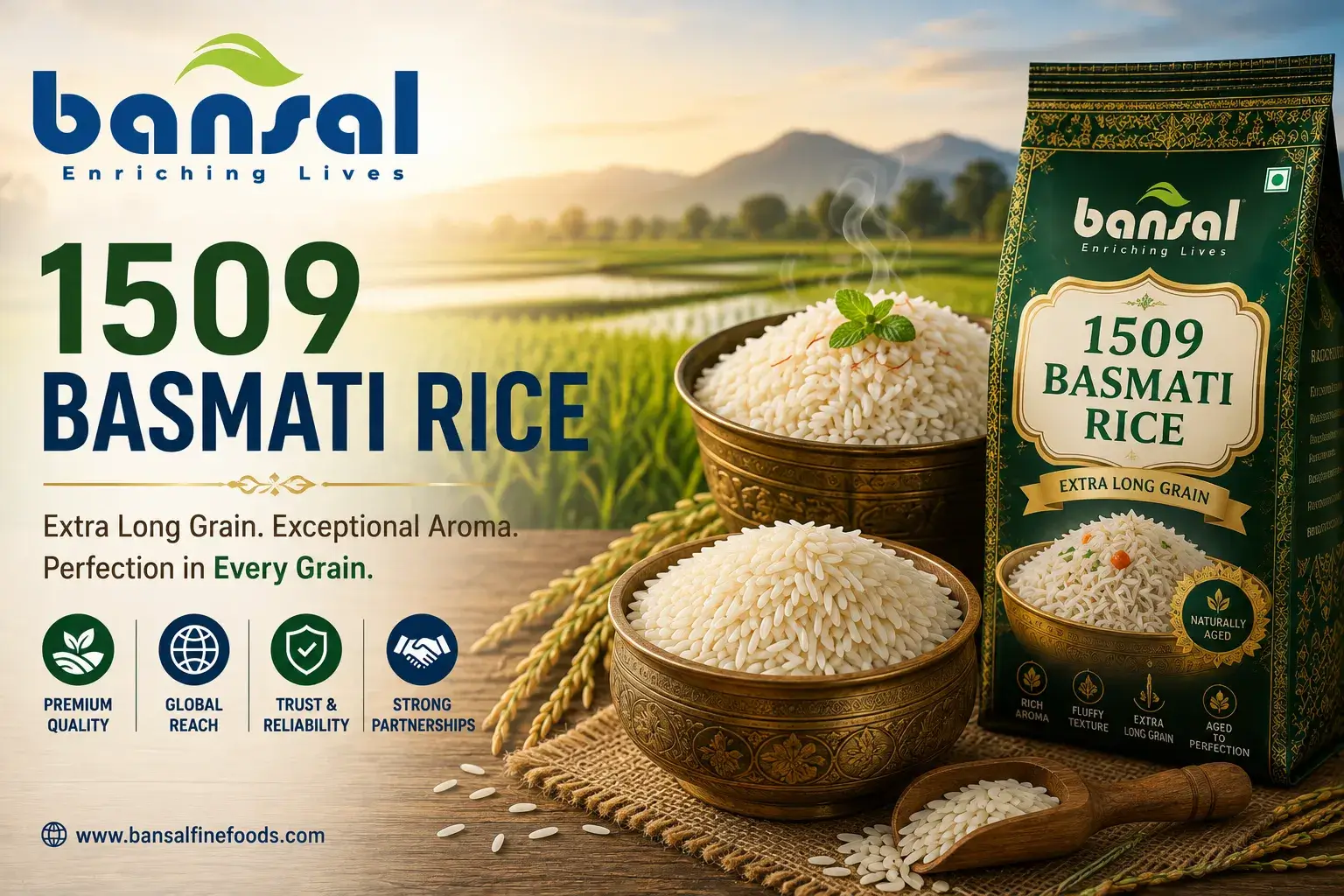
Every basmati buyer eventually asks the same question: is there a variety that delivers genuine basmati quality without the premium price tag of 1121? For a large share of the export market, the answer is 1509 — a variety that has grown from a niche alternative into one of the most actively traded basmati types in the world, precisely because it solves that pricing question well.
1509 is one of the core varieties in Bansal FineFoods’ export basmati range, available through our basmati rice exporter and supplier portfolio alongside 1121, 1401, 1718, and our Pusa and Traditional lines. Here’s what buyers should know before sourcing it.
What Makes 1509 Basmati Rice Different
1509 was developed as an early-maturing basmati variety, and that single trait shapes almost everything else about it. Where 1121 typically needs a longer growing cycle, 1509 reaches harvest in a notably shorter window — generally around 115 to 120 days from sowing. That faster cultivation cycle translates directly into lower production costs, which is the biggest reason 1509 sits at a more accessible price point than 1121 while still delivering long, slender, aromatic grains.
Grain length is genuinely competitive — raw grains run close to 8.4 mm, in the same range as 1121 — but the aroma tends to be somewhat milder, and the elongation on cooking, while still good, doesn’t quite match 1121’s dramatic stretch. For buyers whose end product doesn’t depend on marketing “extra-long grain” as the headline feature, that difference rarely matters in practice.
Key Characteristics of 1509 Basmati Rice
Grain length and appearance — long, slender grains with a slightly greyish tint compared to the off-white appearance of 1121 and 1718, a detail experienced buyers learn to recognize at a glance.
Elongation — solid elongation on cooking, producing distinct, separate grains, though generally not matching the very top end of 1121’s performance.
Aroma — a genuine basmati fragrance, milder than 1121 but still clearly recognizable, which suits a wide range of everyday and commercial cooking applications.
Yield and cost efficiency — because of its shorter growing cycle and strong per-acre yield, 1509 is consistently priced 15-25% below 1121, making it one of the most cost-effective genuine basmati varieties available at export scale.
Cultivation efficiency — 1509 requires less time in the field, which also means farmers can often fit an additional crop cycle into the season, supporting more stable year-on-year supply.
Why 1509 Has Become an Export Favorite
The rice trade runs on margins as much as on flavor, and 1509 sits at a genuinely attractive intersection of the two. It gives importers, private-label brands, and food service buyers a way to offer authentic basmati rice — not a basmati blend or a lower-grade substitute — at a price point that widens their addressable market considerably.
Procurement teams at ready-meal companies and retail chains have increasingly shifted volume from 1121 to 1509 for applications where grain length isn’t the primary selling point, without seeing pushback from end consumers. That’s a meaningful signal: 1509 delivers on the basics — genuine basmati aroma, good texture, reliable cooking performance — well enough that most buyers never notice the difference outside a side-by-side comparison.
Common Uses for 1509 Basmati Rice
- Everyday retail packaging — a strong option for supermarket private-label rice where price competitiveness matters alongside quality
- Ready-meal and food processing — cost efficiency combined with dependable cooking behavior makes it popular with large-scale food manufacturers
- Institutional and bulk catering — a practical choice for high-volume kitchens where cost per kilo affects overall margins
- Everyday home cooking — widely used across South Asian and Middle Eastern households for daily meals, distinct from the “special occasion” positioning of 1121
What to Check When Sourcing 1509 Basmati Rice
- Aging period — 1509 benefits from aging just like other basmati varieties; ask specifically how long the lot has been aged, since younger stock will show noticeably less elongation.
- Grain color consistency — the natural greyish tint of 1509 should be uniform across a batch; excessive variation can indicate mixed-lot sourcing.
- Moisture content and broken percentage — standard due diligence for any export-grade basmati, and 1509 is no exception.
- Yield-season documentation — because 1509 can be harvested more than once in favorable growing regions, ask your supplier which harvest cycle a given lot comes from, as this can affect grain maturity and quality.
- Sample cooking trial — always test before committing to bulk volumes, particularly if you’re substituting 1509 for 1121 in an existing product line.
At Bansal FineFoods, we age and grade our 1509 stock to the same documented standard as our other basmati varieties, so buyers get consistent quality at a genuinely competitive price point.
Where 1509 Is Grown and Why That Matters for Buyers
1509 is cultivated across much of the same basmati-growing belt as 1121 — Punjab, Haryana, and parts of western Uttar Pradesh — but its shorter cultivation cycle gives farmers more flexibility in crop rotation, and in some regions supports a second planting window within the same season. That flexibility has helped keep 1509 supply relatively stable even in years where erratic monsoon timing squeezes yields for longer-duration varieties.
For buyers, this translates into a practical advantage: 1509 availability tends to be less volatile season-to-season than some premium varieties, which supports more predictable pricing for long-term supply contracts. If your procurement strategy depends on price stability as much as grain quality, that’s a factor worth weighing alongside the aroma and elongation comparisons.
The Economics of Switching from 1121 to 1509
For buyers currently sourcing 1121, the calculation for whether 1509 makes sense usually comes down to one question: does your end product’s marketing or plate presentation depend specifically on maximum grain elongation? If the answer is yes — say, you’re supplying a premium restaurant chain or a retail brand built around “extra-long grain” as a core claim — 1121 remains the safer choice. If the answer is no, and your buyers are evaluating the product on taste, aroma, and overall value rather than measuring grain length, a partial or full shift to 1509 can meaningfully improve margins without a corresponding drop in customer satisfaction.
Many of our bulk buyers run this as a phased test: sourcing a portion of their volume as 1509 alongside their existing 1121 supply, running it through a full sales or service cycle, and measuring feedback before deciding whether to shift volume permanently. It’s a low-risk way to validate the switch before committing to it at full scale.
1509 Compared to Other Basmati Varieties
Against 1121, 1509 trades a small amount of aroma intensity and elongation for a meaningfully lower price and faster cultivation cycle. Compared to 1401, 1509 tends to have the cost advantage while 1401 has an edge in shelf stability and MRL compliance history. Against 1718 — which shares a very similar grain length — 1509 is generally the more budget-friendly option, while 1718 offers stronger disease resistance in cultivation, which can translate into more stable year-on-year supply.
For buyers who want real basmati character without paying for maximum grain length, 1509 remains one of the smartest sourcing decisions in the category.
Culinary Applications Where 1509 Performs Best
While 1121 tends to dominate presentation-focused dishes like biryani served at weddings and formal events, 1509 has carved out a strong reputation in everyday and semi-commercial cooking contexts. It performs well in:
- Pulao and mixed rice dishes, where the slightly milder aroma allows other spices and ingredients to come through more clearly
- Fried rice and stir-fried preparations, where excessive stickiness would be a drawback and 1509’s cleaner texture works to its advantage
- Daily household cooking, particularly in markets where basmati is a staple rather than an occasional purchase, and value matters as much as quality
- School and workplace catering programs, where cost efficiency at scale is often the deciding purchase factor
Chefs who work across both varieties often describe 1509 as the more “flexible” rice — less showy than 1121 on the plate, but easier to build a wider range of dishes around without the aroma competing with other ingredients.
Storage and Handling Recommendations for 1509
Because 1509 is frequently purchased in high volumes for cost-sensitive applications, proper storage practices matter for protecting margins as much as quality:
- Store in a cool, dry environment below 25°C, since 1509’s slightly higher moisture sensitivity compared to some varieties can accelerate quality loss if conditions aren’t controlled.
- Rotate stock actively in high-turnover retail and food service settings, where 1509 is often purchased in larger volumes and moves through inventory faster than premium-tier varieties.
- Protect against pest exposure during extended storage in bulk warehouse settings, particularly for buyers holding several months of supply to lock in favorable seasonal pricing.
- Verify packaging integrity on arrival, since high-volume bulk shipments are more prone to handling damage during transit than smaller retail-format orders.
Why Buyers Choose Bansal FineFoods for 1509 Basmati Rice
We supply 1509 basmati rice with the same grading and aging discipline we apply across our full basmati range, which matters more than buyers sometimes expect for a “value” variety — inconsistent 1509 sourcing is one of the most common complaints we hear from buyers who previously sourced elsewhere. Our team documents aging period, moisture content, and broken percentage on every batch, so cost-conscious buyers get predictable quality alongside competitive pricing, not one at the expense of the other.
Frequently Asked Questions
Why is 1509 basmati rice cheaper than 1121?
1509 has a shorter growing cycle — around 115 to 120 days compared to 1121’s longer cultivation period — and higher per-acre yield, which lowers production costs and allows it to be priced 15-25% below 1121 while still delivering genuine basmati quality.
Does 1509 basmati rice taste as good as 1121?
1509 offers a milder aroma and slightly less dramatic elongation than 1121, but the difference is subtle in most cooking applications. Many buyers substitute 1509 for 1121 without any noticeable impact on consumer satisfaction.
What is the grain length of 1509 basmati rice?
Raw grain length is typically close to 8.4 mm, comparable to 1121, though the grains are slightly greyish in color rather than off-white.
Is 1509 basmati rice suitable for bulk export and private-label packaging?
Yes, 1509 is widely used for bulk export, retail private-label packaging, and food processing applications, largely because it combines genuine basmati quality with strong cost efficiency at scale.
How long should 1509 basmati rice be aged before use?
Similar to other basmati varieties, a minimum of 12 months of aging is recommended to develop full aroma and elongation, though buyers focused purely on cost sometimes accept shorter aging periods for everyday retail applications.