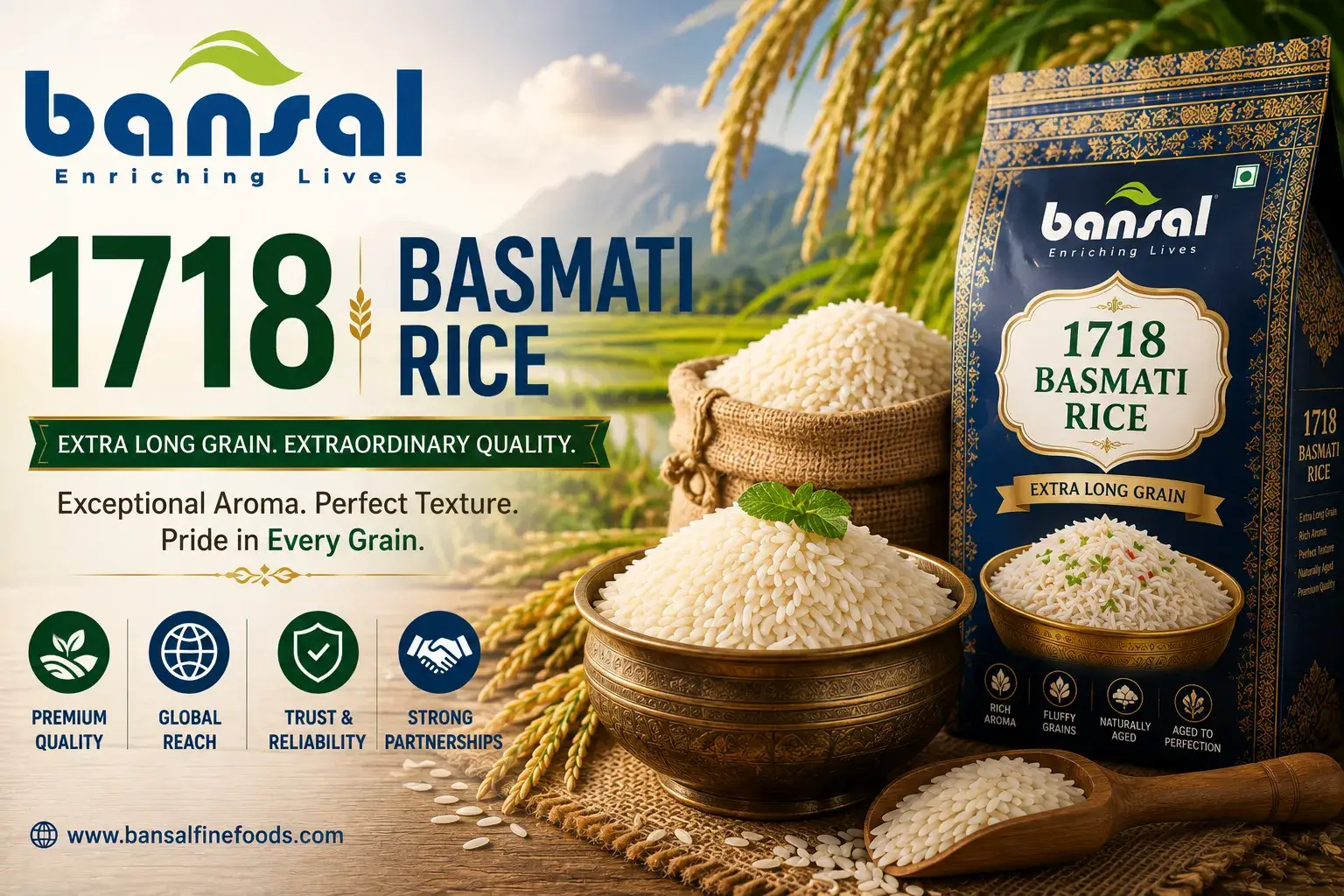
Basmati breeding has always chased two goals at once: better grain quality on the plate, and better reliability in the field. 1718 basmati rice is one of the clearest results of that second pursuit — a variety developed to hold onto the grain characteristics buyers love about 1121, while giving farmers a crop that stands up better to disease pressure and inconsistent monsoon seasons.
1718 is part of Bansal FineFoods’ export basmati range, alongside 1121, 1401, 1509, and our Pusa and Traditional basmati varieties, all available through our basmati rice exporter and supplier portfolio. Here’s what buyers should understand about it.
What Is 1718 Basmati Rice?
Think of 1718 as a refinement rather than a replacement. It was bred to closely match 1121’s exact grain length and aroma profile, while adding meaningfully improved resistance to common rice diseases — particularly bacterial blight, which can devastate yields in years with heavy or erratic rainfall. For farmers, that resilience means a more predictable harvest. For buyers further down the supply chain, it means more stable year-on-year availability of a variety with 1121-grade grain characteristics.
Raw grain length for 1718 runs close to 8.4 mm — comparable to, and by some measurements slightly ahead of, 1121 — with a similar off-white grain appearance that buyers associate with premium basmati.
Key Characteristics of 1718 Basmati Rice
Grain length and elongation — 1718 closely mirrors 1121’s premium grain profile, offering long, slender grains with strong elongation on cooking, making it a near like-for-like substitute where 1121 supply is tight or pricing is under pressure.
Disease resistance — this is 1718’s defining advantage. Improved tolerance to bacterial blight and other common rice diseases gives it more consistent field performance, particularly in growing regions prone to heavy monsoon variability.
Yield stability — because it holds up better under disease pressure, 1718 tends to deliver more reliable yields season over season, which supports more stable supply and pricing for buyers over the long term.
Aroma — a strong, classic basmati fragrance in line with what buyers expect from premium varieties, intensifying nicely on cooking.
Color and appearance — off-white grains with the visual profile export buyers expect from top-tier basmati, holding up well through milling and polishing.
Why 1718 Matters for Long-Term Sourcing Strategy
For buyers who have built a product line around 1121’s specific grain profile, supply consistency is a real operational concern — weather-driven yield swings in any given season can tighten 1121 availability and push prices up unpredictably. 1718 offers a practical hedge: a variety close enough to 1121 in grain length, elongation, and aroma that most buyers can use it interchangeably, but with a cultivation profile that’s less vulnerable to the disease pressures that sometimes squeeze 1121 supply.
This makes 1718 particularly relevant for larger buyers — private-label brands, food service groups, and importers with continuous supply commitments — who need a dependable secondary or blended source alongside 1121, rather than being exposed to a single variety’s seasonal risk.
Common Uses for 1718 Basmati Rice
- Premium retail and export packaging — its grain profile closely matches 1121, making it suitable anywhere 1121-grade quality is expected
- Biryani, pulao, and plated rice dishes — strong elongation and grain separation support the same presentation-driven applications as 1121
- Supply diversification for large buyers — used alongside 1121 to reduce single-variety sourcing risk across a buying program
- Hospitality and catering — reliable grain quality at scale, supporting consistent plate presentation across large volumes
What to Check Before Sourcing 1718 Basmati Rice
- Grain length and elongation testing — request lab documentation confirming 1718’s grain specifications match the quality tier you need.
- Disease-related quality consistency — ask suppliers about crop conditions for the specific season and region the lot was sourced from, since 1718’s resilience advantage is most valuable in difficult growing years.
- Aging period — as with all basmati varieties, confirm how long the stock has been aged before shipment.
- Broken grain percentage and moisture content — standard specifications that should be documented, not estimated.
- Comparative sample trial — if you currently use 1121, request a side-by-side sample of 1718 to confirm it meets your product’s cooking and presentation requirements before switching or blending supply.
Bansal FineFoods sources and grades 1718 to the same documented standard as our 1121 line, making it a straightforward option for buyers looking to diversify supply without compromising on grain quality.
How Farmers and Millers Approach 1718 Differently
From a cultivation standpoint, 1718 has become popular with growers precisely because it reduces the anxiety that comes with betting an entire season on a disease-susceptible variety. In regions where bacterial blight has historically caused significant crop loss in wet years, farmers who shift acreage to 1718 report more consistent outcomes without sacrificing the price premium that 1121-grade grain quality commands at sale.
This has a knock-on effect for millers and exporters too: a more disease-resistant crop generally means more uniform paddy quality arriving at the mill, which translates into more consistent milling yields and less variability in the final graded product. For buyers, that consistency at the cultivation level is part of what supports 1718’s growing reputation as a dependable premium-tier variety, not just a defensive backup to 1121.
Blending Strategy: Using 1718 Alongside 1121
Some of the more sophisticated buyers we work with don’t think of 1718 purely as a substitute for 1121 — they treat it as a blending component. Because the grain length and aroma profiles are so closely matched, blending 1121 and 1718 in varying ratios allows a buyer to manage cost and supply risk without any noticeable shift in the finished product’s appearance or taste. A blend might lean more heavily on 1121 in a season when 1718 harvests are smaller, or vice versa, giving procurement teams a flexible lever rather than a rigid single-variety commitment.
This kind of blending does require a supplier who grades and documents both varieties to a consistent standard — otherwise the blend ratio becomes guesswork rather than a controlled input. It’s a detail worth raising directly with any supplier you’re evaluating for 1718.
1718 Compared to Other Basmati Varieties
Against 1121, 1718 offers a very close match in grain length and aroma, with the added benefit of stronger field-level disease resistance — a meaningful difference for buyers thinking about long-term supply reliability rather than a single shipment. Compared to 1509, 1718 generally commands a higher price but delivers stronger aroma and elongation. Against 1401, the two serve different priorities entirely — 1718 leans toward premium grain characteristics, while 1401 leans toward consistency and residue compliance.
For buyers who want 1121-grade quality with a more resilient supply chain behind it, 1718 is well worth building into a sourcing strategy.
Supply Resilience: A Growing Priority for Basmati Buyers
Climate variability has made supply resilience an increasingly central concern for basmati buyers over the past several years. Erratic monsoon timing, unexpected disease outbreaks, and shifting weather patterns across the basmati-growing belt have all contributed to periodic supply tightness for varieties that are more vulnerable to field conditions. 1718 exists specifically to address that vulnerability without asking buyers to compromise on the grain quality they’ve built their products around.
For buyers who experienced supply disruptions or price spikes with 1121 in previous seasons — a scenario that has played out periodically across the industry — 1718 offers a way to build redundancy into a sourcing strategy without introducing an entirely different grain profile into their product line. It’s a practical answer to a question more buyers are asking as climate variability becomes a bigger factor in agricultural sourcing decisions generally.
Storage and Handling Recommendations for 1718
1718’s premium grain characteristics deserve the same careful handling as 1121 once it reaches your facility:
- Store below 25°C in low-humidity conditions to protect grain length and elongation quality through to end use.
- Avoid prolonged exposure to fluctuating temperatures, which can degrade both aroma and cooking performance over time.
- Keep blended lots clearly labeled and separated if you’re combining 1718 with 1121 or other varieties, so blend ratios remain accurate and traceable.
- Use airtight resealing after opening bulk packaging to preserve freshness for extended storage periods.
Why Buyers Choose Bansal FineFoods for 1718 Basmati Rice
We position 1718 as a genuine premium-tier variety in our range, not a fallback option — graded to the same specifications as our 1121 line, with documentation covering grain length, elongation, aging, and moisture content on every batch. For buyers building supply resilience into their sourcing strategy, our team can advise on blend ratios and help structure standing orders that balance 1121 and 1718 supply based on seasonal availability.
Frequently Asked Questions
Is 1718 basmati rice the same as 1121?
Not exactly the same, but very close. 1718 was bred to match 1121’s grain length and aroma profile closely, with the key difference being improved resistance to common rice diseases, which supports more stable field yields.
Why would a buyer choose 1718 over 1121?
Buyers often choose 1718 for supply diversification. Its grain quality closely matches 1121, but its stronger disease resistance can mean more reliable availability and pricing during difficult growing seasons.
What is the grain length of 1718 basmati rice?
Raw grain length is approximately 8.4 mm, comparable to and by some measures slightly longer than 1121, with similar elongation performance on cooking.
Can 1718 basmati rice be used interchangeably with 1121 in product formulations?
In most cases, yes. The grain length, aroma, and cooking performance are close enough that many buyers use 1718 as a direct substitute or blend it with 1121 without noticeable differences in the final product.
Does Bansal FineFoods offer sample lots of 1718 basmati rice for testing?
Yes, we provide sample lots for cooking trials before bulk orders. You can explore our full basmati range on our basmati rice exporter and supplier page.