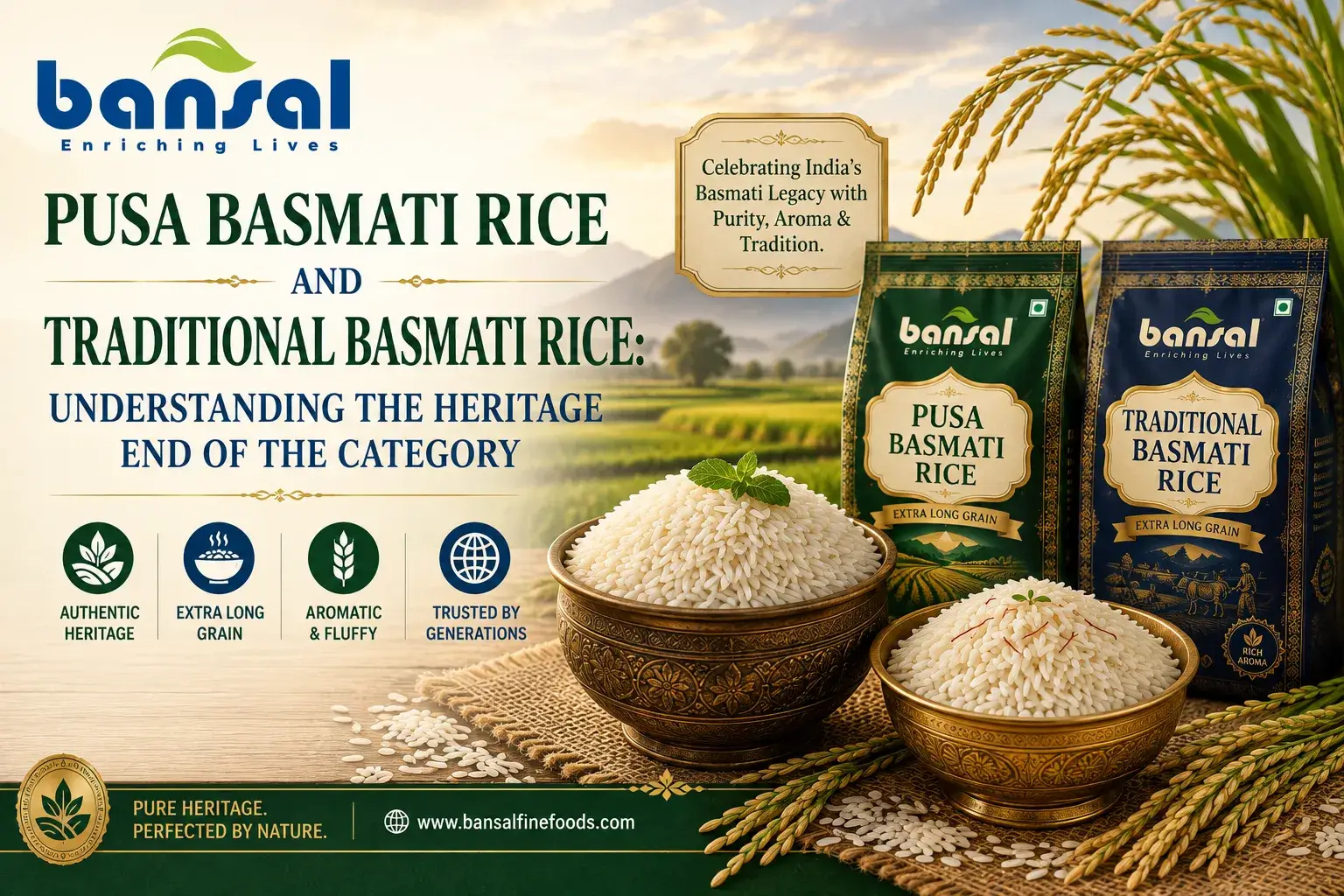
Most of the conversation around basmati export today revolves around numbers — 1121, 1401, 1509, 1718 — hybrid varieties bred for grain length, yield, and consistency. But behind those modern cultivars sits an older story: the research institute that developed many of them, and the traditional basmati strains that have been grown in the Himalayan foothills for generations, long before any of these numbered varieties existed. Understanding both — Pusa basmati and Traditional basmati — helps buyers make sense of where the entire basmati category comes from.
Both varieties are available through Bansal FineFoods’ basmati rice exporter and supplier range, alongside 1121, 1401, 1509, and 1718.
What Is Pusa Basmati Rice?
“Pusa” refers to the Indian Agricultural Research Institute’s Pusa campus in New Delhi, the institution responsible for developing most of India’s modern basmati varieties — including 1121, 1509, and 1718 themselves are technically “Pusa Basmati” cultivars, carrying the Pusa name in their formal variety registration. When buyers search for “Pusa basmati rice” as a standalone term, they’re often referring to the foundational Pusa Basmati varieties — robust, long-grain rice bred for strong yield, dependable cooking performance, and a solid, well-rounded flavor profile.
Pusa Basmati rice typically delivers:
- Strong yield per acre — a key reason Pusa varieties became the backbone of India’s basmati export economy
- Long, straight kernels — grains that cook relatively quickly compared to some other basmati types, while staying non-sticky and well-separated
- Reliable aroma — a robust basmati fragrance without being the most intense in the category
- Consistent cooking behavior — a dependable choice for buyers who value predictability across large order volumes
In short, Pusa basmati represents the scientific, high-yield foundation of the modern basmati trade — the research lineage that every numbered variety in this category, from 1121 to 1718, ultimately traces back to.
What Is Traditional Basmati Rice?
Traditional basmati — sometimes labeled Basmati 370 or Dehraduni basmati — is a different story altogether. This is the original basmati: a non-hybrid variety cultivated for generations in the foothills of the Himalayas across Punjab, Haryana, Uttarakhand, and parts of Pakistan, long before agricultural research institutes began breeding for grain length and yield.
Traditional basmati doesn’t try to compete with 1121 on grain length — at roughly 7 mm raw, its grains are noticeably shorter than the modern hybrids. What it offers instead is depth of aroma. Traditional basmati is often described as the “Queen of Fragrances” for good reason: its natural aromatic compounds are considered by many connoisseurs, chefs, and gourmet retailers to be the richest and most complex in the entire basmati category.
Key characteristics include:
- Shorter grain length — around 7 mm raw, distinctly shorter than 1121, 1509, or 1718
- Exceptional aroma — widely regarded as the most fragrant basmati variety available, with a depth that hybrid varieties haven’t fully replicated
- Texture — grains soften and swell noticeably on cooking, giving a fuller, richer mouthfeel than the leaner texture of long-grain hybrids
- Nutritional profile — good protein and fiber content, low in fat, in line with basmati rice generally
- Lower yield — because it’s grown using traditional cultivation practices rather than high-yield hybrid breeding, Traditional basmati is produced in smaller volumes, which supports its premium positioning
Why Buyers Choose Pusa vs. Traditional Basmati
The choice between these two really comes down to what a buyer’s end product is optimized for.
Choose Pusa basmati when you need dependable yield-backed supply, straightforward cooking performance, and a solid basmati profile at accessible pricing — a strong option for bulk institutional buyers, food processors, and retailers focused on value and consistency.
Choose Traditional basmati when aroma and heritage positioning are the primary selling point — gourmet retailers, specialty restaurants, premium gift packaging, and brands building a story around authenticity and terroir tend to gravitate toward Traditional basmati specifically because grain length isn’t the feature being marketed; fragrance and heritage are.
It’s also worth noting that many premium basmati blends in the market combine a hybrid variety like 1121 for visual grain length with a smaller proportion of Traditional basmati for aroma depth — a detail some suppliers won’t volunteer unless asked directly.
Common Applications
- Bulk export and institutional supply
- Everyday retail packaging
- Food processing and ready-meal production
- Catering and food service where reliability matters more than heritage positioning
- Gourmet and specialty retail
- Premium gift and festival packaging
- High-end restaurant and hospitality menus
- Brands marketing authenticity, heritage, or GI-tagged provenance
What to Check Before Sourcing Either Variety
- Variety verification — ask suppliers to confirm whether “Pusa basmati” refers to a specific registered cultivar or is being used as a general umbrella term; specification clarity matters for contracts.
- Aging period — both varieties benefit from proper aging, though Traditional basmati in particular is often aged longer to fully develop its signature aroma.
- Grain length and moisture testing — standard due diligence, with particular attention to consistency for Traditional basmati given its smaller-scale, less industrialized cultivation.
- Certification and provenance documentation — for Traditional basmati marketed on heritage or GI-tagged claims, ask for supporting documentation rather than taking positioning at face value.
- Sample cooking trials — especially valuable when comparing Traditional basmati’s texture and aroma against hybrid varieties for the first time.
Bansal FineFoods sources and grades both Pusa and Traditional basmati to documented specifications, giving buyers clarity on exactly what they’re purchasing, whether the priority is yield-backed consistency or heritage-grade aroma.
The GI Tag and What It Means for Traditional Basmati Buyers
Basmati rice grown in the designated Geographical Indication (GI) region — spanning parts of Punjab, Haryana, Himachal Pradesh, Uttarakhand, Delhi, and western Uttar Pradesh — carries legal protection recognizing it as authentic basmati under Indian and international GI frameworks. Traditional basmati varieties, given their long cultivation history in this exact belt, are closely associated with GI-tagged provenance, which has become an increasingly important credibility marker for buyers in premium and export markets.
For gourmet retailers, specialty food brands, and buyers marketing authenticity as a core selling point, being able to trace Traditional basmati back to verified GI-region cultivation isn’t just a nice-to-have — it’s often a contractual or labeling requirement, particularly in markets with strict food provenance regulations. If GI documentation matters for your buyers, confirm early in supplier discussions whether the specific lot you’re sourcing carries verifiable regional traceability, rather than assuming all “traditional basmati” claims are backed by the same level of documentation.
How Blenders Use Traditional Basmati with Hybrid Varieties
One detail rarely discussed openly in the trade: a meaningful share of the “premium basmati” sold in supermarkets and used in high-end restaurants isn’t a single pure variety at all. It’s a blend — typically a hybrid like 1121 for grain length and visual appeal, combined with a smaller proportion of Traditional basmati to lift the aroma profile beyond what the hybrid alone would deliver. Blend ratios vary by brand and price tier, but even a 10-20% addition of well-aged Traditional basmati can noticeably deepen the fragrance of a 1121-based product.
For buyers considering this approach, it’s worth sourcing both components from a supplier who can document the aging and quality of each separately, so the blend ratio is a deliberate formulation decision rather than an approximation.
How These Varieties Fit Into a Broader Sourcing Strategy
For many buyers, the smartest approach isn’t choosing one basmati variety exclusively but building a portfolio: 1121 or 1718 for premium, grain-length-driven products; 1509 or 1401 for cost-efficient, high-consistency applications; and Pusa or Traditional basmati where yield reliability or heritage aroma positioning is the priority. Understanding where each variety sits in that spectrum is what separates a commodity purchase from a genuinely informed sourcing decision.
Positioning Pusa and Traditional Basmati in a Product Line
Brands and buyers building a tiered basmati offering often use Pusa and Traditional basmati at opposite ends of their range. Pusa basmati, or one of its numbered hybrid descendants, typically anchors the accessible, everyday tier — reliable quality at a price point that supports high-volume distribution. Traditional basmati, by contrast, anchors the premium or heritage tier — smaller volumes, higher price points, and positioning built around authenticity, aroma, and story rather than sheer grain length.
This kind of tiered strategy lets a single buyer or brand serve multiple customer segments without diluting either message: value-focused customers get dependable quality through Pusa-lineage rice, while customers willing to pay for a heritage, gourmet experience get a genuinely different product in Traditional basmati, not simply the same rice repackaged at a higher price. Getting that segmentation right starts with sourcing both varieties from a supplier who can back up the distinction with real grading and provenance data.
Storage and Handling Recommendations
Both Pusa and Traditional basmati benefit from careful post-purchase handling, though Traditional basmati in particular rewards extra care given its premium positioning:
- Store below 25°C in a dry, well-ventilated space, particularly important for Traditional basmati, whose aroma compounds are more sensitive to heat and humidity exposure than some hybrid varieties.
- Protect Traditional basmati from prolonged light exposure, which can gradually diminish its signature fragrance over extended storage.
- Keep Pusa basmati stock rotated actively in high-volume institutional settings to maintain consistent cooking quality across batches.
- Reseal opened packaging promptly for both varieties to prevent moisture pickup and preserve grain integrity through to final use.
Why Buyers Choose Bansal FineFoods for Pusa and Traditional Basmati
We supply both ends of this spectrum with the documentation to match — yield and grading data for Pusa basmati buyers who need dependable bulk consistency, and aging and provenance detail for Traditional basmati buyers building a heritage or GI-backed positioning. Our team can also advise on blend formulations for buyers looking to combine hybrid grain length with Traditional basmati’s aroma depth in a single product line.
Frequently Asked Questions
What is the difference between Pusa basmati and Traditional basmati rice?
Pusa basmati refers to modern, research-bred varieties developed at IARI’s Pusa campus, optimized for yield and consistent cooking performance. Traditional basmati is a non-hybrid variety grown for generations in the Himalayan foothills, valued primarily for its exceptional natural aroma rather than grain length or yield.
Is Traditional basmati rice more expensive than hybrid varieties like 1121?
It can be, particularly for well-aged, high-quality lots, since Traditional basmati is produced in smaller volumes using traditional cultivation methods. Pricing depends heavily on aging, sourcing region, and quality grade.
Which is better for export, Pusa basmati or Traditional basmati?
It depends on the end market. Pusa basmati suits buyers who need consistent, high-yield supply for bulk or institutional use. Traditional basmati suits buyers targeting gourmet, specialty, or heritage-positioned segments where aroma and authenticity are the primary selling points.
Does Traditional basmati rice have a shorter grain than 1121?
Yes. Traditional basmati typically measures around 7 mm raw, noticeably shorter than 1121’s approximately 8.3-8.4 mm, though it’s known for a richer, more complex aroma.
Can Bansal FineFoods supply both Pusa and Traditional basmati rice for export?
Yes, both varieties are available with documented grading and aging specifications. You can view our complete basmati range on our basmati rice exporter and supplier page.