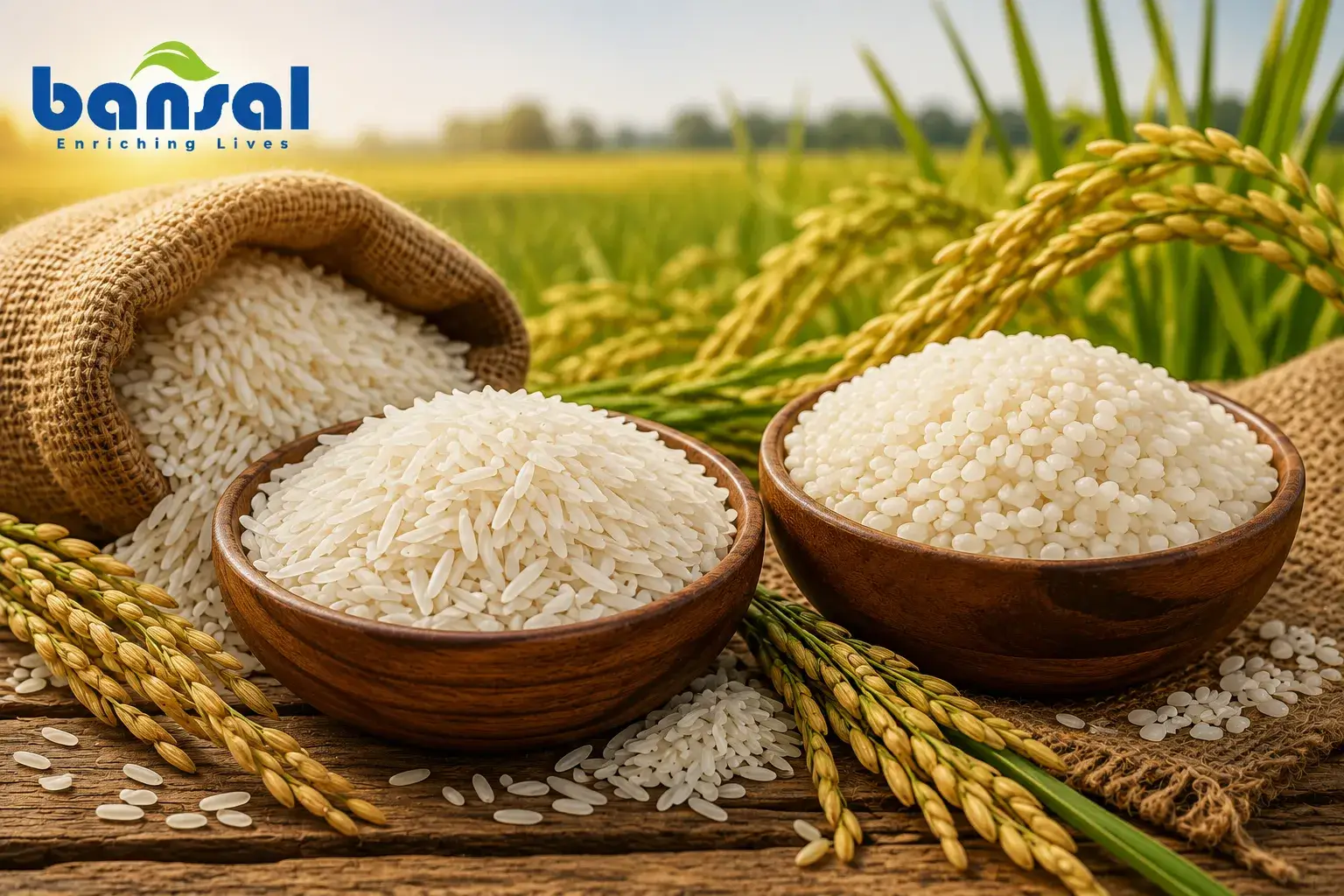
If there’s a single variety that defines global non-basmati rice trade, it’s IR64. It’s cultivated across millions of hectares worldwide, exported in enormous volumes, and used as a benchmark against which many other bulk rice varieties are compared. Alongside it, round rice — a broader category of short and round-grain non-basmati rice — serves a different but equally important role in markets where texture and culinary tradition favor a shorter, stickier grain over long-grain varieties.
Both are part of Bansal FineFoods’ non-basmati portfolio, available through our non-basmati rice exporter and supplier range alongside Sugandha, Sharbati, RH10, PR11, and PR106.
What Is IR64 Rice?
IR64 was developed by the International Rice Research Institute (IRRI) and released in the Philippines in 1985, representing a major breakthrough at the time in combining high yield with genuinely good eating quality — a combination earlier high-yield varieties hadn’t fully achieved. It went on to become one of the most widely cultivated rice varieties in history, grown across more than 10 million hectares globally within two decades of its release, and its genetics have since been used extensively in breeding programs for newer varieties.
In India, IR64 is grown primarily in Uttar Pradesh and Haryana, and it remains one of the most heavily exported non-basmati rice varieties, prized for its long, slender grains, intermediate cooking quality, and — critically for a commodity-scale crop — its consistent affordability at volume.
Key Characteristics of IR64 Rice
Grain structure — long, slender grains with a light color that holds up well through milling and export-scale processing.
Cooking quality — good palatability with intermediate amylose content, giving it a balanced texture that’s neither overly sticky nor excessively dry, a quality that contributed significantly to its global success as a high-yield variety that didn’t sacrifice eating experience.
Disease resistance — IR64 carries strong resistance to blast and bacterial blight, two of the most damaging rice diseases, which supports more stable yields and reduces supply volatility for buyers.
Availability and pricing — as one of the most widely cultivated rice varieties globally, IR64 benefits from stable, large-scale supply, keeping pricing competitive and predictable for bulk buyers.
Export track record — IR64’s decades-long trading history means established shipping, documentation, and quality-grading practices are well understood across the international rice trade, reducing friction for buyers new to sourcing it.
What Is Round Rice?
“Round rice” refers to short and round-grain non-basmati rice varieties, distinct from the long, slender grains of IR64, Sugandha, or basmati types. Where long-grain rice is prized for separate, fluffy grains after cooking, round rice is valued for the opposite quality: a softer, stickier texture with grains that cling together, which suits an entirely different set of culinary traditions and applications.
Round rice varieties are commonly used in dishes where a cohesive, softer texture is actually the goal — congee and porridge preparations, certain South and East Asian rice dishes, and some processed food applications where the rice needs to hold together rather than separate. For export buyers supplying markets or cuisines built around these preparations, round rice fills a role that long-grain varieties simply can’t.
Common Applications
- Bulk export for general-purpose cooking across diverse cuisines
- Retail and wholesale distribution where affordability and consistency matter most
- Food processing and parboiled rice production
- Government and institutional food supply programs
- Congee, porridge, and softer rice preparations
- Specific South and East Asian culinary applications requiring a stickier texture
- Processed food products where grain cohesion is a functional requirement
- Niche export markets with cuisine-specific rice texture preferences
IR64’s Global Legacy and Why It Still Matters
IR64’s story is genuinely unusual in agricultural terms. Few rice varieties in history have achieved its combination of cultivation scale, geographic spread, and genetic influence on subsequent breeding programs. Even as its own cultivation area has declined somewhat in recent decades — gradually replaced by newer varieties bred from its own genetic lineage — IR64 remains a reference point across the global rice trade, and many of the varieties that have partially replaced it in some growing regions are, genetically speaking, its direct descendants.
For buyers, this legacy translates into something concrete: a deep, well-established base of trading infrastructure, quality benchmarks, and market familiarity that newer varieties often take years to build. When a buyer sources IR64, they’re tapping into decades of accumulated trading practice, which reduces friction and uncertainty compared to sourcing a less-established variety, even one with genuinely comparable grain quality.
Buyer Segmentation: Who Sources IR64 vs. Round Rice
The buyer profiles for these two categories are genuinely distinct, which is worth understanding clearly rather than treating them as interchangeable “non-aromatic rice” options.
IR64 buyers are typically operating at commodity scale — wholesale distributors, large retailers, food processors, and government supply programs that need dependable, affordable long-grain rice in significant volumes, without aromatic or textural specialization driving the purchase decision.
Round rice buyers, by contrast, are usually sourcing for a specific culinary or cultural application. A food manufacturer producing congee or rice porridge products, a restaurant group specializing in cuisines that call for stickier rice textures, or an ethnic grocery distributor serving a community with specific rice-texture preferences — these buyers are purchasing round rice because their end product genuinely requires that particular grain structure, not as a cost-driven substitution for long-grain rice.
Supply Chain Considerations for High-Volume Buyers
Because IR64 is traded at such enormous global scale, its supply chain is generally more resilient to localized disruptions than more geographically concentrated varieties — if one growing region faces a difficult season, the sheer breadth of IR64 cultivation across different countries and regions helps buffer global availability more effectively than would be possible with a narrower, single-region variety. That said, India’s periodic export policy adjustments on non-basmati rice have, at times, affected international IR64 availability, underscoring the value of working with a supplier who can advise on current regulatory conditions rather than assuming past export patterns will always hold.
Round rice, by contrast, tends to have a more concentrated, specialized supply base given its narrower buyer segment. Buyers sourcing round rice for a specific application should factor in longer lead times for larger orders and build relationships with suppliers who understand the specific textural and processing requirements of their end use, rather than treating round rice sourcing as a simple commodity purchase.
What to Check Before Sourcing IR64 or Round Rice
- Grain specifications — request documented grain length and structure, since “IR64” and “round rice” both cover meaningful variation depending on growing region and processing method.
- Moisture content and broken grain percentage — standard due diligence for any bulk export order, particularly important given the high volumes typically involved with IR64.
- Disease-resistance and crop-quality documentation — while IR64 carries strong inherent disease resistance, ask suppliers about seasonal crop conditions for the specific lot you’re sourcing.
- Processing method — confirm whether you need raw, parboiled, or specifically processed round rice, since applications vary considerably by processing type.
- Sample cooking trial — particularly important for round rice buyers, since the correct texture profile is central to its intended use.
Storage and Handling Recommendations
- Store below 25°C in a dry, ventilated warehouse to maintain grain quality across high-volume bulk storage.
- Implement strict first-in, first-out rotation, especially relevant for IR64’s typically large-volume, fast-turnover buyer base.
- Handle round rice with attention to moisture control, since its stickier grain structure can be more sensitive to humidity-related quality changes than long-grain varieties.
- Verify packaging integrity on arrival for bulk shipments transported over long international routes.
Why Buyers Choose Bansal FineFoods for IR64 and Round Rice
We supply IR64 with the documentation and consistency that bulk export buyers depend on — grain specifications, moisture content, and broken percentage confirmed on every batch — alongside round rice sourced and processed to match specific culinary and textural requirements. Whether you’re managing a high-volume standing order or sourcing a smaller specialty lot of round rice for a niche application, our team works directly with buyers to match grade and processing to end use.
How These Fit Alongside Our Broader Non-Basmati Range
IR64 typically anchors the high-volume, general-purpose end of a non-basmati sourcing strategy, while round rice serves specific culinary niches that long-grain varieties can’t address. Alongside Sugandha and Sharbati for aromatic positioning, RH10 for premium fine-grain quality, and PR11 and PR106 for bulk institutional supply, IR64 and round rice round out a sourcing portfolio built to serve nearly any non-basmati application a buyer might need.
Two Varieties, Two Very Different Jobs
IR64 and round rice rarely compete for the same order — they serve fundamentally different purchasing needs, one built around volume and affordability, the other around a specific textural requirement that only a handful of grain types can satisfy. Understanding that distinction clearly helps buyers avoid the common mistake of treating all “non-aromatic, non-basmati” rice as interchangeable, when in practice the right choice depends entirely on what the end dish or product actually requires.
Frequently Asked Questions
What makes IR64 rice so widely used in global export?
IR64 combines high yield, strong disease resistance, and genuinely good eating quality, a combination that made it one of the most widely cultivated rice varieties in history. Its long trading history also means established, well-understood export and grading practices across the international rice trade.
What is round rice used for?
Round rice is a short, round-grain non-basmati rice valued for its softer, stickier texture after cooking. It’s commonly used in congee, porridge, and specific South and East Asian dishes where grain cohesion is desired rather than separate, fluffy grains.
Is IR64 rice suitable for parboiled processing?
Yes, IR64 is commonly processed into parboiled form for export, which improves shelf stability and nutrient retention for buyers managing long transit and storage periods.
How is round rice different from long-grain varieties like IR64?
Round rice has a shorter, rounder grain structure and a stickier cooked texture, suited to different culinary applications than long-grain varieties, which are valued for separate, fluffy grains after cooking.
Does Bansal FineFoods supply both IR64 and round rice for export?
Yes, both are available with documented grading and processing specifications. Explore our complete non-basmati range on our non-basmati rice exporter and supplier page.