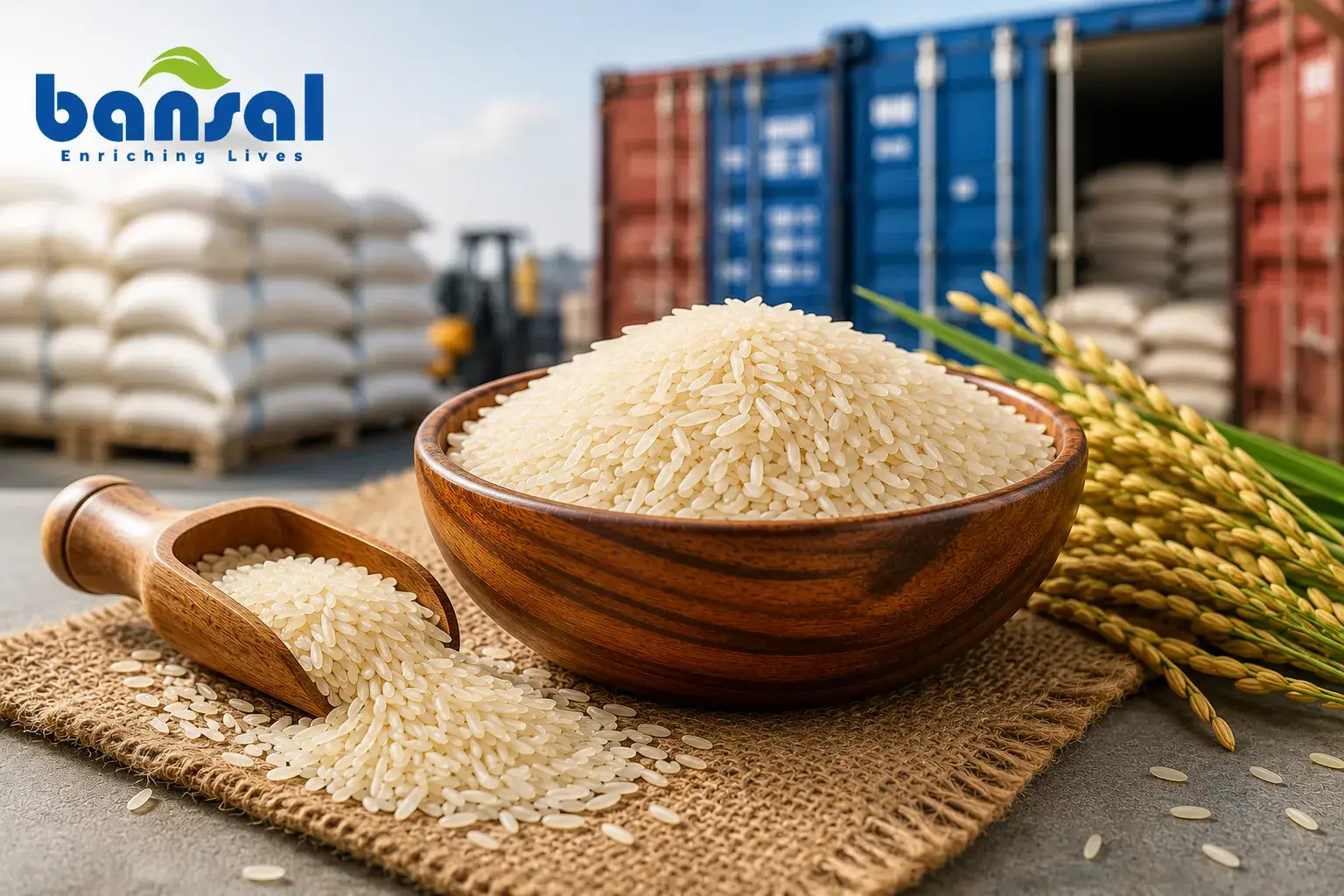
If PR11 is the institutional workhorse of Punjab’s rice belt, PR106 is its close cousin — a long-grain variety cultivated across the same core growing regions, sharing many of the same practical advantages that make it a reliable choice for buyers who prioritize consistency and volume over aromatic distinction.
PR106 is part of Bansal FineFoods’ non-basmati range, available through our non-basmati rice exporter and supplier portfolio alongside Sugandha, Sharbati, RH10, PR11, and IR64. This post covers what makes PR106 a dependable sourcing choice.
What Is PR106 Rice?
PR106 is a long-grain, non-basmati rice variety developed for cultivation primarily in Punjab and Haryana, part of the broader family of PR-series varieties bred by Punjab Agricultural University for reliable yield and grain quality under North Indian growing conditions. It shares meaningful similarities with IR64 — long grains, dependable cooking behavior, and a positioning geared toward bulk and commercial buyers rather than aromatic or presentation-focused markets — but with a slightly longer grain profile that some buyers specifically prefer.
Most PR106 is consumed and traded in parboiled form, a processing method that enhances the rice’s firmness and nutritional retention while extending its shelf stability — a detail that matters considerably for export buyers managing long transit times and extended warehouse storage.
Key Characteristics of PR106 Rice
Grain length — slightly longer than IR64, giving PR106 a marginal edge for buyers whose product positioning benefits from a more elongated grain appearance without stepping into aromatic-variety pricing.
Parboiling suitability — PR106 is particularly well suited to parboiled processing, which firms up the grain structure and improves nutrient retention compared to raw milling, making it a preferred choice for buyers specifically sourcing parboiled non-basmati rice.
Cultivation region — concentrated in Punjab and Haryana, benefiting from established agricultural infrastructure and consistent seasonal yield in these core rice-growing states.
Cooking behavior — firm, non-sticky texture after cooking, particularly pronounced in its parboiled form, suited to bulk catering and food service applications where texture consistency across large batches matters.
Nutritional profile — parboiled PR106 retains more of its natural vitamin and mineral content compared to raw-milled rice, a detail increasingly relevant to buyers positioning products around nutritional value.
Why Parboiled PR106 Appeals to Export Buyers
Parboiling has become an increasingly important processing choice in the export rice trade, largely because it extends shelf life and improves the rice’s resilience to the temperature and humidity fluctuations common during long ocean freight transit. PR106’s natural suitability for parboiling — combined with its already firm grain structure — makes it a particularly strong candidate for buyers shipping into markets with extended supply chains, where product stability from origin to shelf is a genuine commercial concern.
This has helped PR106 build a solid export reputation independent of any aromatic or premium positioning; buyers choose it specifically because it holds up reliably through the logistics challenges that come with international bulk rice trade.
Common Uses for PR106 Rice
- Parboiled rice export — a natural fit given its structural suitability for parboiling and extended shelf stability
- Bulk institutional and commercial catering — dependable cooking behavior across large batch preparation
- Government and large-scale food distribution programs — consistent with the broader PR-series positioning toward high-volume, cost-controlled procurement
- Wholesale and value-tier retail distribution — competitive pricing suited to cost-conscious bulk buyers
Understanding the Parboiling Process
Parboiling is a partial-boiling process applied to paddy rice before milling, and it’s worth understanding in some detail given how central it is to PR106‘s export positioning. The paddy is soaked, steamed, and then dried before milling, a process that gelatinizes the starch within the grain and drives nutrients from the outer bran layer further into the grain itself. The practical results are threefold: the milled grain becomes firmer and more resistant to breakage, it retains more of its natural nutrient content compared to raw milling, and it becomes noticeably more resistant to the temperature and moisture fluctuations that can degrade rice quality during long storage or transit.
For a variety like PR106, which already has a naturally firm grain structure, parboiling amplifies these advantages further — which is a large part of why parboiled PR106 has built such a strong reputation specifically among export buyers rather than domestic retail buyers, who more often prefer raw-milled rice for everyday cooking.
Export Corridors and Buyer Segments
PR106, particularly in parboiled form, has found consistent demand across export corridors where buyers value shelf stability as much as base grain quality — markets with long shipping routes, buyers managing extended warehouse storage before final distribution, and food service operators who need rice that performs consistently regardless of how long it’s been sitting in inventory.
This has positioned PR106 somewhat differently from its PR-series relative PR11: while PR11 leans heavily toward domestic institutional and government-supply markets, PR106‘s parboiling suitability has given it a stronger independent export identity, particularly among buyers specifically searching for parboiled non-basmati rice rather than general bulk long-grain rice.
Nutritional Positioning for Parboiled PR106
The parboiling process gives PR106 a nutritional story that raw-milled rice generally can’t match, and it’s a detail worth highlighting for buyers building retail or food service positioning around health-conscious consumers. Because parboiling drives nutrients from the bran layer into the grain itself before milling, parboiled PR106 retains meaningfully more of its natural vitamin and mineral content than raw-milled long-grain rice, where much of that nutrition is lost during polishing.
This has made parboiled rice generally, and PR106 specifically given its strong suitability for the process, an increasingly relevant option for buyers targeting nutrition-focused retail segments or institutional buyers — school meal programs, hospital catering, and similar contexts — where nutrient retention is a genuine procurement consideration rather than just a marketing angle.
What to Check Before Sourcing PR106 Rice
- Parboiling specifications — if sourcing parboiled stock specifically, confirm the parboiling process and resulting moisture content are documented and consistent across batches.
- Grain length verification — request lab-tested measurements, particularly if you’re comparing PR106 against IR64 for a specific product application.
- Broken grain percentage — standard due diligence for any bulk export order.
- Shelf life and storage stability documentation — especially relevant for buyers managing long transit routes or extended warehouse holding periods.
- Sample cooking trial — test both raw and parboiled forms if you’re undecided on which processing method suits your end application.
Storage and Handling Recommendations
- Store parboiled PR106 in a dry, well-ventilated environment, though it generally shows better resilience to humidity fluctuations than raw-milled rice varieties.
- Maintain consistent temperatures below 25°C where possible to preserve grain integrity over extended storage periods.
- Use first-in, first-out rotation for bulk institutional and wholesale stock to maintain consistent quality across shipments.
- Verify packaging integrity on arrival, particularly for large bulk shipments transported over long distances.
Why Buyers Choose Bansal FineFoods for PR106 Rice
We supply PR106 in both raw and parboiled forms, with documented grain length, moisture content, and processing specifications on every batch. For export buyers managing long supply chains, our team can advise on the parboiling and packaging combination best suited to your specific transit and storage conditions, helping ensure the rice arrives at destination in the same condition it left our facility.
PR106 Compared to Other Non-Basmati Varieties
Against PR11, PR106 offers a slightly longer grain profile and stronger natural suitability for parboiling, while both serve similar bulk institutional markets. Compared to IR64, PR106 holds a modest grain-length advantage, which some buyers specifically select for. Against aromatic varieties like RH10 or Sugandha and Sharbati, PR106 competes on volume, shelf stability, and cost rather than fragrance.
A Strong Choice for Long-Distance Export Programs
For buyers whose primary concern is getting rice from origin to destination market without quality degradation along the way, PR106 — particularly in its parboiled form — solves a genuinely practical problem that many other varieties don’t address as well. Its combination of structural firmness, nutrient retention, and shelf stability makes it a dependable foundation for export programs spanning long shipping routes and extended storage periods.
Frequently Asked Questions
What is PR106 rice best used for?
PR106 is widely used for parboiled rice export, bulk institutional catering, and government food distribution programs, where its firm texture and shelf stability are particularly valuable across long supply chains.
Is PR106 rice similar to IR64?
Yes, the two share a broadly similar profile as long-grain, bulk-oriented non-basmati varieties, though PR106 typically has a slightly longer grain and stronger natural suitability for parboiling.
Why is PR106 rice often sold in parboiled form?
Parboiling firms up PR106’s grain structure, improves nutrient retention, and extends shelf stability, making it especially well suited to the extended transit and storage conditions common in international rice export.
Is PR106 rice suitable for bulk export?
Yes, its structural resilience and shelf stability, particularly in parboiled form, make it a strong candidate for export buyers managing long shipping routes and extended warehouse storage.
Does Bansal FineFoods supply PR106 rice in both raw and parboiled forms?
Yes, we offer PR106 in both forms with documented processing and grading specifications. Explore our full non-basmati range on our non-basmati rice exporter and supplier page.