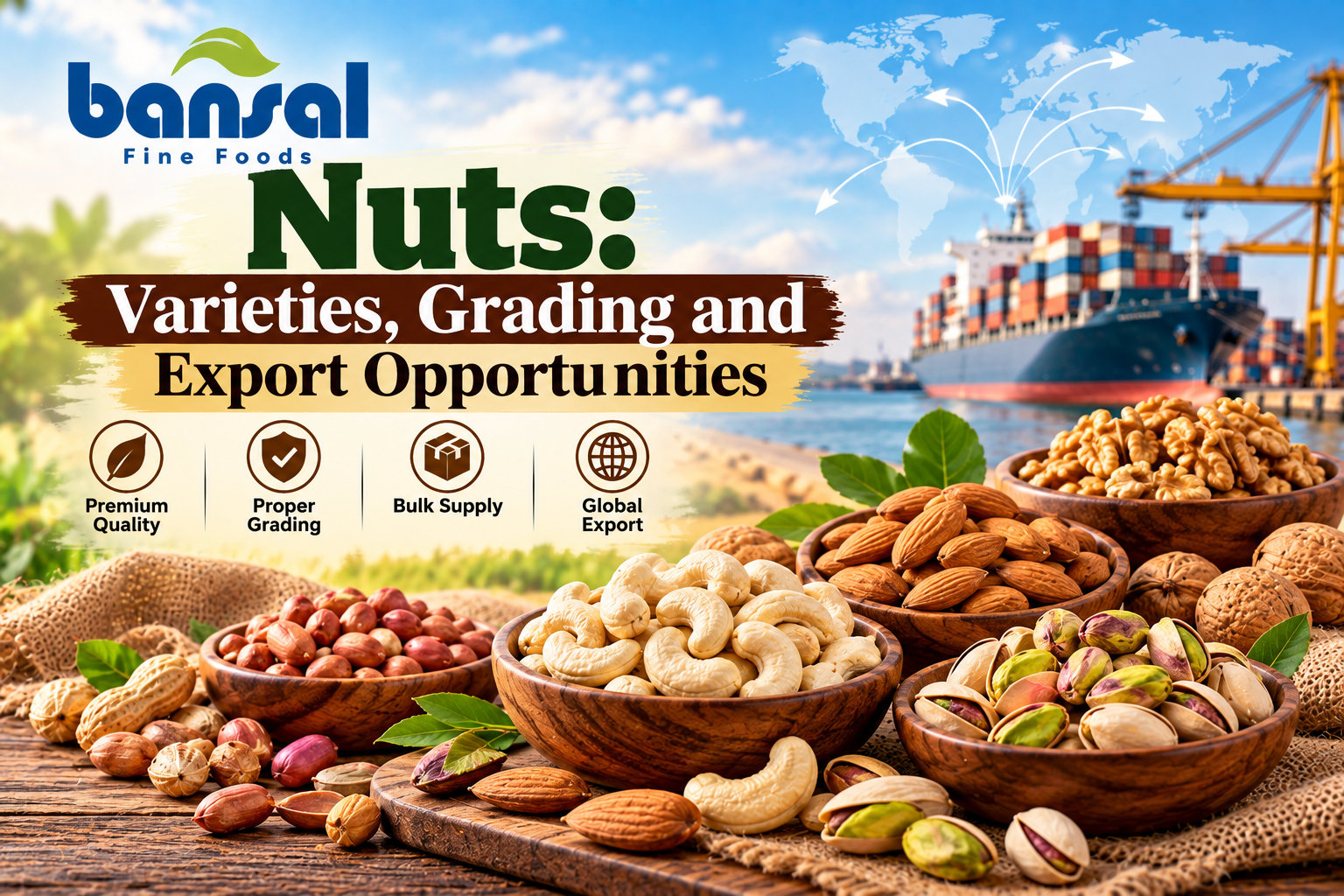
Nuts have moved well beyond the festive dry fruit box. Today they are a core ingredient for bakeries, confectioners, snack brands, hotels, caterers, retailers and health-food businesses. Buyers want nuts that are fresh, uniformly graded, free of contamination and delivered on time, whether they order a few hundred kilos for a local market or full containers for export.
That puts a lot of weight on the choice of partner. A good nuts supplier does more than sell a product. It sources carefully, grades honestly, packs properly and delivers consistently. A strong nuts manufacturer controls processing, hygiene and shelf life. And a capable nuts exporter handles the paperwork and logistics that keep international shipments moving.
Bansal Fine Foods works across food staples such as rice and pulses, and our nuts range is built on the same principle: consistent quality and clear specifications. This blog explains the main nut varieties, how grading works, what to look for in a supplier, and how bulk and export orders are typically handled.
Why Demand for Nuts Keeps Growing
Health-conscious eating. Nuts are naturally rich in healthy fats, protein, fibre and a range of vitamins and minerals. As more consumers look for wholesome snacks and plant-based nutrition, demand rises steadily.
Food industry use. Nuts go into sweets, baked goods, chocolates, cereals, energy bars, ice cream, sauces and ready-to-eat meals. Manufacturers need reliable volume and consistent size and quality.
Gifting and festive demand. In India and across many export markets, nuts remain a staple of festivals, weddings and corporate gifting.
Growth of private-label and retail packs. Retailers and e-commerce sellers increasingly want custom-branded packs, which raises the need for suppliers who can handle flexible packaging.
Popular Nuts We Supply
Cashew Nuts
Cashews are among the most widely traded nuts. Their mild, buttery taste and creamy texture make them suitable for snacking, cooking, curries, sweets and dairy-free alternatives. Cashew kernels are graded by size and quality, with grades such as W180, W210, W240, W320 and W450, where “W” refers to white wholes and the number reflects roughly how many kernels make up a pound. Lower numbers mean larger kernels. Broken and split grades are also available for processing and confectionery.
Almonds
Almonds are valued for their crunch, versatility and nutritional profile. Buyers use them whole, sliced, slivered or blanched in snacks, sweets, bakery products, milk and spreads. Size, uniformity, colour and moisture matter here, and different grades suit retail packs, food service and manufacturing.
Pistachios
Pistachios have a distinctive flavour and colour and are popular for snacking, desserts, ice cream and gifting. They are supplied in-shell and as shelled kernels. Buyers look at split rate, kernel colour, size and taste when selecting a lot.
Walnuts
Walnuts are known for their rich, slightly earthy flavour. They are used in baking, salads, snacks and sweets, and are sold as in-shell walnuts, kernels and broken pieces. Light-coloured, fresh-tasting kernels command higher grades, while darker or broken kernels suit processing.
Peanuts
Peanuts (groundnuts) are a high-volume product used for snacking, peanut butter, oil, confectionery and food processing. Varieties are graded by kernel size and count, and quality checks such as moisture and aflatoxin levels are particularly important in this category.
Please note that availability of individual varieties and grades can vary by season and sourcing region. Contact our team to confirm the current range for your requirement.
How Nuts Are Graded
Understanding grading helps you avoid paying for quality you do not need, or accepting quality you cannot use.
Size. Nuts are sorted by size or count. Larger, uniform nuts usually cost more and are preferred for premium retail and gifting.
Whole versus broken. Whole kernels look better and sell at a premium. Splits, pieces and broken grades are more economical and work well in bakery, confectionery and processed foods.
Colour and appearance. Consistent colour indicates careful handling and storage. Discolouration, spots or shrivelled kernels lower the grade.
Moisture content. Proper moisture keeps nuts crisp and prevents mould and spoilage during storage and transport.
Foreign matter and defects. Shell fragments, husk, insect damage and other defects should stay within agreed limits.
Taste and freshness. Nuts should taste clean and fresh, with no rancid or stale notes.
Always ask your supplier to state the grade and specification in writing, and confirm it against a sample.
What Makes a Reliable Nuts Supplier?
Nuts are a high-value, sensitive commodity. Small lapses in handling can affect flavour, safety and shelf life. Here is what separates a dependable supplier from an average one.
Transparent sourcing. A good nuts supplier knows where its nuts come from and can explain the sourcing chain, whether domestic or imported.
Consistent quality. The lot you receive should match the sample you approved. Repeat buyers depend on this consistency.
Clear specifications. Grade, size, moisture, defects and packaging should all be defined before an order is confirmed.
Hygienic handling and storage. Nuts absorb odours and are prone to moisture and pests. Clean, dry, well-ventilated storage matters.
Fair and honest pricing. Reliable suppliers explain what drives price differences between grades instead of hiding them.
Responsive communication. From quotation to delivery, buyers need timely, straightforward answers.
The Role of a Nuts Manufacturer
Many businesses need more than raw nuts in a bag. A nuts manufacturer takes nuts through processing steps that add value and meet specific needs.
Cleaning and sorting. Removing foreign matter, damaged kernels and off-colour pieces.
Shelling and peeling. Producing shelled kernels, blanched almonds and other prepared forms.
Grading and sizing. Separating nuts by size and quality for consistent lots.
Roasting and seasoning. Producing roasted, salted or flavoured nuts for snacking and retail.
Cutting and processing. Making slices, slivers, halves, pieces and powders for bakery and food manufacturing.
Packing. Filling retail pouches, food-service packs and bulk cartons, with options such as vacuum packing or nitrogen flushing to extend shelf life.
Working with a supplier that also handles manufacturing means fewer handovers, tighter quality control and more flexibility on specifications. It also helps businesses that need private-label production or custom cuts.
Nuts Export: What Importers Should Expect
Buying nuts across borders involves more moving parts than a local purchase. A capable nuts exporter manages these details so that shipments arrive on time and in good condition.
Specification agreement. Variety, grade, quantity, packaging and quality parameters are agreed and documented before shipment.
Sampling and approval. Importers normally approve a sample first. The shipment is then prepared against that approved sample.
Documentation. Export shipments typically require a commercial invoice, packing list, bill of lading or airway bill, certificate of origin and phytosanitary certificate. Depending on the destination, additional certificates such as a certificate of analysis or fumigation certificate may be needed. Importers should confirm requirements with their own customs authorities.
Packaging for transit. Export packing is designed to protect nuts from moisture, crushing and temperature swings. Common formats include vacuum-packed cartons, tins and food-grade bags.
Shipping terms. Terms such as FOB, CFR and CIF define who pays for and manages each stage of transport. A good exporter explains these clearly and helps you choose what suits your business.
Regulatory and safety compliance. Importing countries have their own food-safety rules, including limits on contaminants such as aflatoxin. A responsible nuts exporter is aware of these standards and prepares shipments accordingly.
Quality and Food Safety in the Nuts Trade
Food safety is not optional in this category. Buyers should look for suppliers who take these areas seriously:
- Aflatoxin and contaminant control, especially for peanuts, pistachios and almonds
- Moisture management to prevent mould and rancidity
- Pest control and hygienic storage
- Traceability, so a lot can be tracked back to its source if a question arises
- Relevant certifications and licences, such as FSSAI registration for the Indian market and other food-safety standards that apply to the destination market
If a certification matters to you, ask for the certificate itself instead of relying on a verbal assurance.
Packaging Options for Nuts
The right packaging protects quality and supports your brand.
- Bulk cartons and bags for manufacturers and large-volume buyers
- Vacuum-packed cartons to preserve freshness during storage and transit
- Retail pouches and jars for supermarkets and online sellers
- Gift boxes and festive packs for corporate and seasonal demand
- Private-label packing with your own brand, design and labelling
Discuss shelf-life targets and end-use with your supplier, as these influence the best packaging format.
Why Choose Bansal Fine Foods as Your Nuts Supplier, Manufacturer and Exporter?
Bansal Fine Foods brings the same discipline we apply to our rice and pulses to the nuts we supply. When you work with us, you can expect:
- A focused range of popular nuts, including cashews, almonds, pistachios, walnuts and peanuts
- Grade-based supply, so you receive what you specified
- Attention to sorting, cleaning and packing at every stage
- Flexible order sizes, from trial quantities to bulk and container orders
- Custom and private-label packaging to suit your market
- Export documentation support and coordination of shipments for international buyers
- Clear communication on pricing, availability, timelines and terms
- One partner for multiple categories, since you can also source from our [Basmati Rice], [Non Basmati Rice] and [Pulses] ranges
Whether you run a retail brand, a bakery, a hotel chain, a trading company or an import business, our team can help you choose the right nut, grade and packaging for your needs.
How to Choose the Right Nuts Supplier for Your Business
- Define your requirement. Decide the nut type, grade, form (whole, split, sliced or powder) and annual volume.
- Ask for samples. Check size, colour, taste, crunch and freshness before ordering in bulk.
- Review the specification sheet. Confirm moisture, defects, foreign matter and packaging in writing.
- Check food-safety credentials. Ask about licences, certifications and testing practices.
- Compare total value, not just price. A slightly higher price for consistent quality and reliable delivery often costs less in the long run.
- Start with a trial order. A smaller first order shows how the supplier handles quality, packing and delivery.
Frequently Asked Questions About Buying Nuts in Bulk
1. What is the minimum order quantity for nuts?
It varies by nut type, grade and packaging. Trial orders and bulk orders are both common. Contact our team with your requirement to get exact quantities and terms.
2. Can I get samples before placing a bulk order?
Sampling is standard in the nuts trade. Buyers typically approve a sample against the agreed specification before confirming a larger order.
3. What do cashew grades like W320 and W240 mean?
“W” stands for white wholes, and the number indicates the approximate count of kernels per pound. A lower number, such as W180 or W210, means larger kernels, while W320 is a smaller size.
4. How long can nuts be stored?
Shelf life depends on the nut, moisture level, packaging and storage conditions. Stored cool, dry and airtight, most nuts keep well for several months, and vacuum or nitrogen packing can extend freshness further.
5. Do you offer private-label packaging?
Custom and private-label packaging can be discussed based on the nut type, pack size and order volume.
6. What documents are needed for a nuts export shipment?
Typically a commercial invoice, packing list, bill of lading or airway bill, certificate of origin and phytosanitary certificate, plus any extra certificates your destination country requires.
7. How can I tell if nuts are fresh?
Fresh nuts have a clean, pleasant aroma, even colour and a crisp bite. A stale, bitter or oily smell suggests the nuts have gone rancid.
Conclusion
Whether you are stocking a retail shelf, feeding a production line or filling a container for export, the quality of your nuts depends heavily on the partner behind them. A dependable nuts supplier, manufacturer and exporter gives you consistent grades, careful processing, safe handling and smooth delivery.
Bansal Fine Foods is committed to delivering exactly that. Explore our range of nuts and contact us today for samples, pricing and bulk or export enquiries.