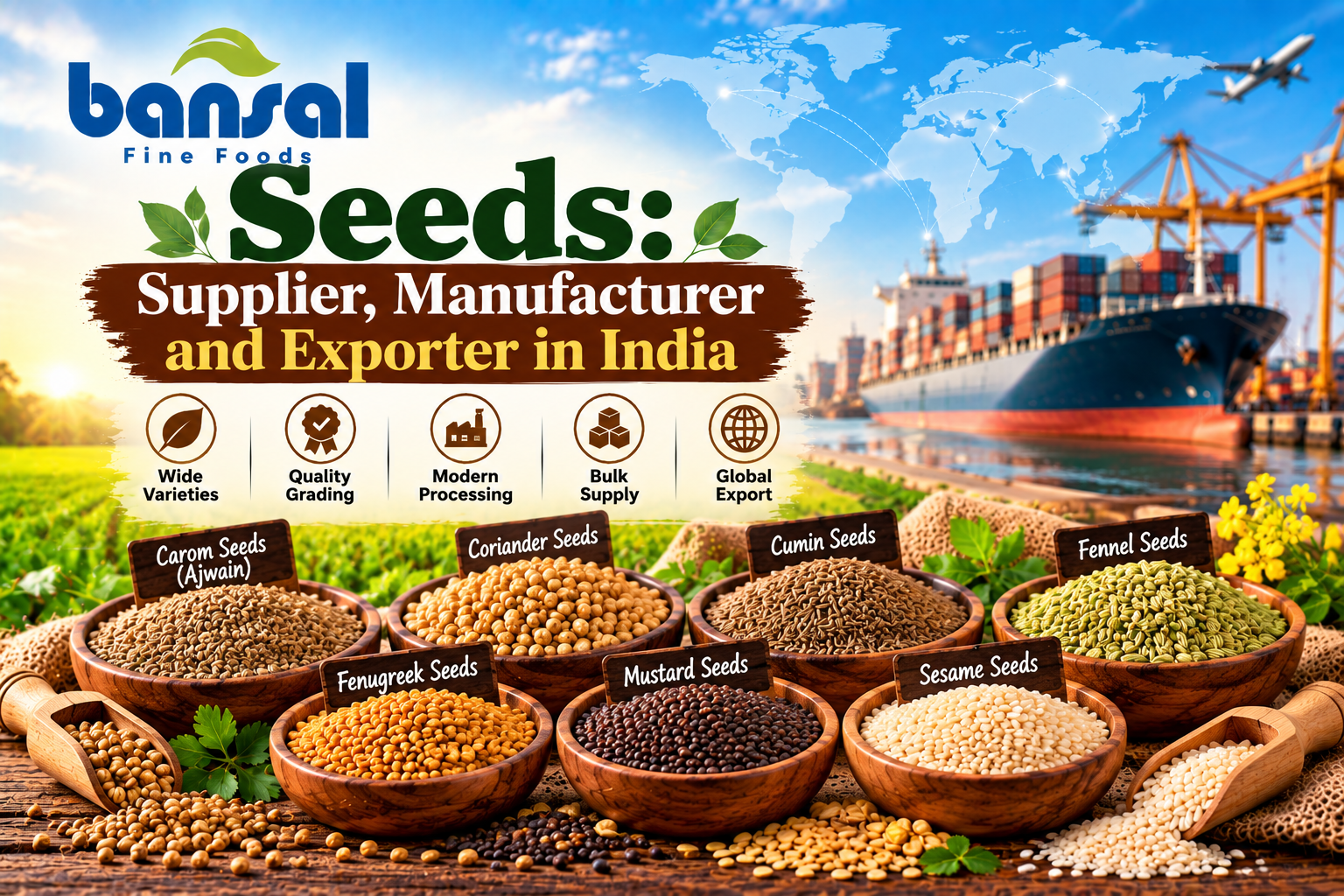
Open almost any Indian spice tin and you will find a set of small seeds doing a disproportionate amount of work. Cumin in a tadka, mustard popping in hot oil, fennel finishing a meal, ajwain settling a stomach, coriander grounding a curry, fenugreek adding bitterness to a pickle, sesame toasted over a sweet. These culinary and spice seeds are used every day across Indian households, and they are traded in large volumes to food manufacturers, spice blenders, exporters and retailers around the world.
For buyers, the challenge is finding a seeds supplier who can deliver consistent quality across varieties and seasons, a seeds manufacturer who processes and grades the product properly, and a seeds exporter who manages documentation and shipping without delays. As a seeds manufacturer in india and seeds exporter india, Bansal Fine Foods works with businesses that need dependable supply, whether that is a domestic spice blender or an international importer.
This blog covers the main seeds we supply, how quality is judged, what to expect from export shipments, and how to choose the right partner for bulk sourcing.
Why India Is a Major Source for Culinary Seeds
India grows and trades a wide range of spice and culinary seeds across states such as Rajasthan, Gujarat, Madhya Pradesh and Uttar Pradesh. Favourable growing conditions, established farming and processing networks, and deep culinary demand at home make India one of the world’s leading sources for cumin, coriander, fennel, fenugreek, mustard, sesame and carom seeds. This scale gives buyers access to a wide range of grades and consistent seasonal supply, provided they work with a supplier who sources and processes carefully.
Popular Seeds We Supply
Carom Seeds (Ajwain)
Carom seeds are small, oval and greyish-brown, with a strong, slightly bitter flavour and a sharp aroma similar to thyme. They are used in parathas, snacks like mathri, pickles and digestive preparations. Buyers typically look for uniform seed size, a clean aroma and low moisture. As a carom seeds exporter in India, Bansal Fine Foods supplies both domestic buyers and international importers who use ajwain in food products and traditional preparations. Whether you need a carom seeds supplier for retail packs or a carom seeds manufacturer in India for bulk processing, our team can match the grade to your requirement. We also work as a general carom seeds exporter for buyers who need consistent volume.
Coriander Seeds
Coriander seeds are round to oval, light brown and have a mild, citrusy, slightly sweet aroma. They are ground into one of the most widely used spice powders in Indian cooking and are also used whole in pickles and tempering. Quality is judged on seed size, colour, aroma and oil content, with certain regional varieties commanding higher demand for their stronger fragrance. As a coriander seeds supplier, we offer graded lots suited to grinding, whole-seed use and export packing. For international buyers, we operate as a coriander seeds exporter india to India’s key markets, with consistent sourcing and documentation support.
Cumin Seeds
Cumin seeds are among India’s most exported spices. They are slender, ridged and brown, with a warm, earthy aroma that is central to Indian, Middle Eastern and Mexican cuisines. Cumin is graded by seed size, colour, oil content and purity, and machine-clean, sortex-processed cumin is in high demand for its low foreign-matter content. As a cumin seeds manufacturer, Bansal Fine Foods processes and grades cumin to meet buyer specifications. We supply as a cumin seeds supplier to domestic wholesalers and food manufacturers, and as a cumin seeds exporter for bulk international orders.
Fennel Seeds
Fennel seeds are pale green to yellowish-brown, with a sweet, mildly liquorice-like flavour. They are used in cooking, as a post-meal mouth freshener (saunf), and in traditional preparations. Larger, uniformly green seeds are generally valued more highly. As a fennel seeds exporter, we supply graded lots for both food and traditional-use markets, and as a fennel seeds manufacturer, we handle cleaning, grading and packing to buyer specifications.
Fenugreek Seeds
Fenugreek seeds are small, hard, yellowish-brown and angular, with a distinctly bitter, slightly sweet aroma when roasted or cooked. They are used in pickles, spice blends, certain breads and traditional preparations, and fenugreek is also processed into products used in food and other industries. As a fenugreek seeds supplier, Bansal Fine Foods offers cleaned, graded seeds suited to both culinary and processing use.
Mustard Seeds
Mustard seeds come mainly in black, brown and yellow varieties, each with a different pungency and use. They are essential for tempering, pickling and mustard oil production, and are widely traded both within India and internationally. As a mustard seeds supplier, we offer variety-specific grading based on colour, size and oil content, suited to food processing, retail and export requirements.
Sesame Seeds
Sesame seeds are small, flat and oval, available in white, brown and black varieties. They are used in bakery products, confectionery, tahini, oil extraction and traditional sweets, and are one of India’s most significant seed exports. Hulled and natural (unhulled) sesame serve different markets, with hulled sesame commonly used in bakery and confectionery for its lighter colour and cleaner taste. As a sesame seeds exporter, Bansal Fine Foods supplies both hulled and natural sesame to international buyers. As a sesame seeds manufacturer, we handle cleaning and grading in-house, and as a sesame seeds supplier, we serve bakery, oil-processing and retail buyers.
Availability of individual seeds and grades can vary with the season and crop. Contact our team to confirm current stock for your requirement.
How Seeds Are Processed and Graded
Good seeds do not arrive at their final quality by accident. A dependable seeds manufacturer manages several stages carefully.
Cleaning. Raw seeds contain dust, stones, husk and plant debris that must be removed before packing.
Sorting and grading. Seeds are sorted by size, colour and density to create uniform lots. Sortex (optical) sorting removes discoloured, damaged or foreign material for a cleaner product.
Moisture control. Correct moisture levels prevent mould, clumping and loss of aroma during storage and transit.
Purity testing. Buyers, especially exporters, often test for purity percentage, foreign matter, admixture and, where relevant, essential oil content.
Packing. Finished seeds are packed into retail pouches, bulk bags or export cartons depending on the buyer’s needs, often with attention to moisture-barrier packaging for seeds prone to losing aroma.
Consistent processing is what allows a buyer to reorder the same product, batch after batch, without surprises.
What to Check Before Buying Seeds in Bulk
Whether you are sourcing for retail, food manufacturing or export, these checks help you avoid a poor lot.
- Purity percentage. Higher purity means less foreign matter and fewer defective seeds.
- Moisture content. Seeds with excess moisture are prone to mould and reduced shelf life.
- Aroma and oil content. Especially important for cumin, coriander, fennel and sesame, where flavour strength drives quality perception.
- Colour uniformity. A consistent colour usually indicates careful sorting and storage.
- Foreign matter and admixture. Stones, husk, dust and other seed types should be within agreed limits.
- Sample approval. Always request and test a sample before confirming a bulk order.
What Makes a Reliable Seeds Supplier?
The seeds trade covers many varieties, seasons and quality grades, so reliability matters more than a low quote. A dependable seeds supplier should offer:
Transparent sourcing, so you know where and how the seeds are procured.
Consistent quality, where the delivered lot matches the approved sample every time.
Clear specifications for purity, moisture, foreign matter and packaging, stated in writing.
Proper storage, since seeds are sensitive to humidity, pests and temperature.
Flexible order sizes, from trial quantities to bulk and export volumes.
Responsive communication on availability, pricing and lead times.
Seeds Export: What International Buyers Should Expect
Working with a seeds exporter india partner involves a few standard steps that protect both sides of the transaction.
Specification agreement. Variety, grade, purity, moisture and packaging are confirmed before shipment.
Sampling and approval. Importers typically approve a sample before the bulk order is processed.
Documentation. Export shipments generally require a commercial invoice, packing list, bill of lading or airway bill, certificate of origin and phytosanitary certificate. Some destinations may also require a fumigation certificate or a certificate of analysis, particularly for food-grade seeds.
Export packaging. Seeds are typically packed in moisture-resistant bags or cartons, in sizes ranging from retail packs to 25 kg and 50 kg bags or bulk containers, chosen to protect aroma and prevent spoilage in transit.
Shipping terms. Terms such as FOB, CFR and CIF define responsibilities at each stage, and a good seeds exporter explains these clearly before confirming an order.
Regulatory compliance. Food-grade seed exports must meet the importing country’s food-safety standards, which can include limits on pesticide residue and microbial contamination. A responsible exporter stays current with these requirements.
Packaging Options for Seeds
The right packaging protects both quality and shelf life.
- Retail pouches for supermarkets and online sellers
- Bulk bags, typically 25 kg or 50 kg, for wholesale and food manufacturing
- Export cartons and moisture-barrier packaging for long transit
- Private-label packing with custom branding for retailers and distributors
Why Choose Bansal Fine Foods for Seeds?
Bansal Fine Foods applies the same sourcing and quality discipline across rice, pulses, nuts and seeds. When you work with us as your seeds supplier, seeds manufacturer or seeds exporter, you can expect:
- A focused range, including carom, coriander, cumin, fennel, fenugreek, mustard and sesame seeds
- Careful cleaning, sorting and grading for consistent quality
- Specification-based supply, so what you approve is what you receive
- Flexible order sizes, from trial lots to full container loads
- Custom and private-label packaging for retail, wholesale and export
- Export documentation support and coordination as a seeds manufacturer in india and reliable exporter
- A single partner for multiple categories, alongside our [Basmati Rice], [Non Basmati Rice], [Pulses] and [Nuts] ranges
Whether you are a spice blender, food manufacturer, retailer or international importer, our team can help you choose the right seed variety and grade for your business.
How to Choose the Right Seeds Supplier for Your Business
- Identify your requirement. Decide which seeds, grades and quantities you need.
- Request a sample. Check aroma, colour, moisture and purity before committing to a bulk order.
- Confirm the specification sheet. Purity percentage, moisture, foreign matter and packaging should be agreed in writing.
- Ask about processing. Understand how the seeds are cleaned, sorted and stored.
- Compare on total value. Consistent quality and reliable delivery are often worth more than the lowest price.
- Start with a trial order to evaluate quality, packing and communication before scaling up.
Frequently Asked Questions About Buying Seeds in Bulk
1. Which seeds does Bansal Fine Foods supply?
We supply carom (ajwain), coriander, cumin, fennel, fenugreek, mustard and sesame seeds, among other spice and culinary seeds. Contact our team to confirm current availability.
2. What is the minimum order quantity for seeds?
It depends on the seed type, grade and packaging. We work with both trial orders and bulk export volumes.
3. Can I get a sample before placing a bulk order?
Yes, sampling is standard practice in the seeds trade. Buyers typically approve a sample against the agreed specification before confirming a larger order.
4. What is the difference between hulled and natural sesame seeds?
Hulled sesame has had the outer husk removed, giving a lighter colour and milder taste, commonly used in bakery and confectionery. Natural (unhulled) sesame retains the husk and has a stronger flavour, often used in traditional cooking and oil extraction.
5. What documents are needed to export seeds from India?
Typically a commercial invoice, packing list, bill of lading or airway bill, certificate of origin and phytosanitary certificate, plus any additional certificates the destination market requires, such as a certificate of analysis.
6. How should seeds be stored to preserve aroma?
Keep them in a cool, dry, airtight container away from moisture, heat and direct sunlight. Proper packaging during transit and storage helps retain natural oils and aroma for longer.
7. Do you offer private-label packaging for seeds?
Custom and private-label packing can be arranged based on the seed type, pack size and order volume.
Conclusion
Carom, coriander, cumin, fennel, fenugreek, mustard and sesame seeds are small in size but central to Indian cooking and to global spice and food industries. The right seeds supplier, seeds manufacturer and seeds exporter can make the difference between a consistent product and an unpredictable one.
Bansal Fine Foods brings careful sourcing, proper processing and export support to every seed variety we handle. Explore our range of seeds and contact Bansal Fine Foods today for samples, pricing and bulk or export enquiries.