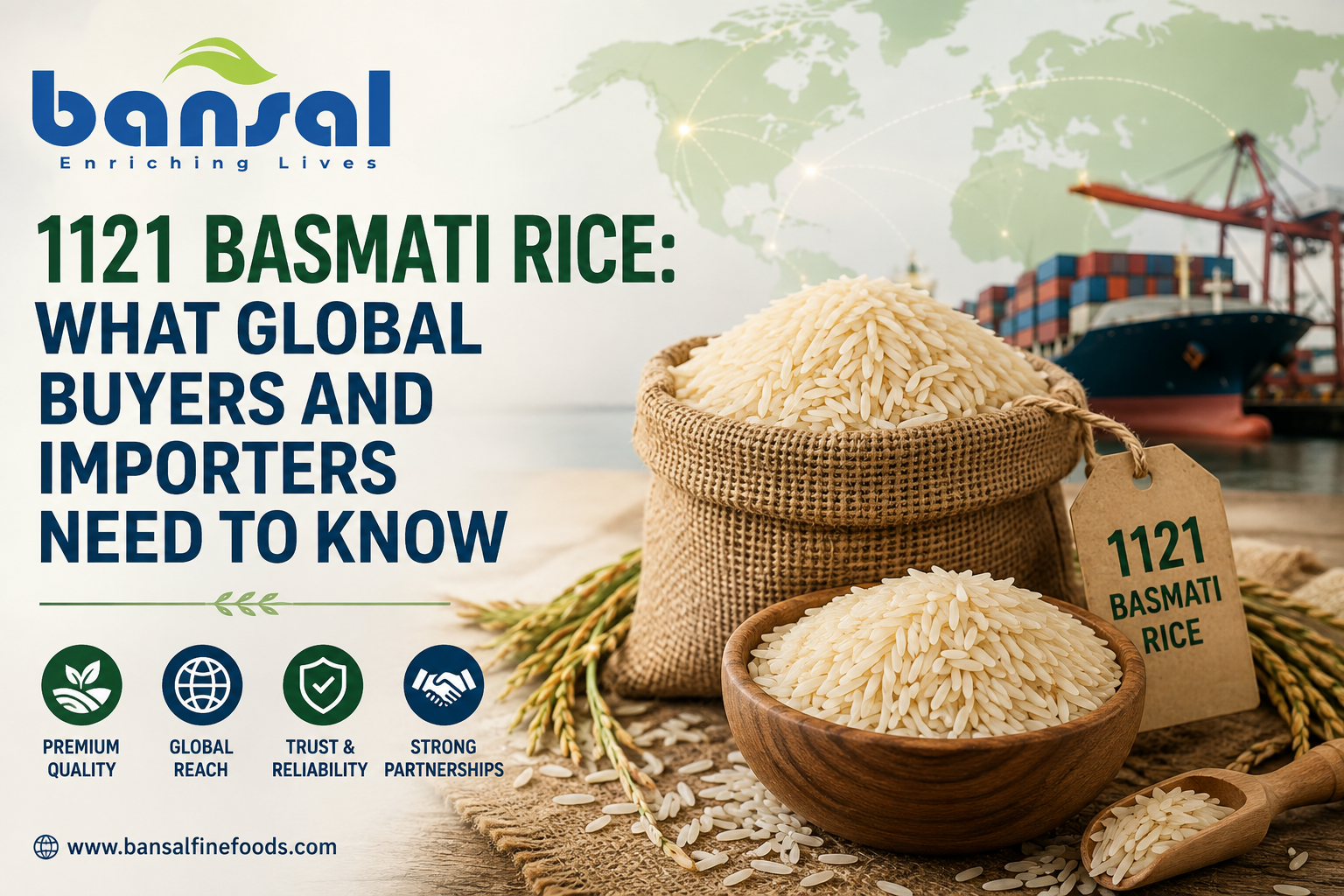
If you have spent any time sourcing rice for export, retail packaging, or hospitality supply, you have already run into one number more than any other: 1121. Ask a miller in Karnal, a wholesaler in Dubai, or a chef plating biryani in London what “premium basmati” means to them, and 1121 is usually the first answer. It has become the benchmark variety against which every other basmati type is measured — and for buyers building a supply chain around it, understanding why matters as much as knowing where to source it.
At Bansal FineFoods, 1121 basmati rice forms the backbone of our export basmati portfolio, alongside our other core varieties, all available through our basmati rice exporter and supplier range. This piece walks through what makes 1121 distinct, how it performs across different markets, and what to check for before you commit to a supplier.
Where 1121 Basmati Rice Comes From
1121 basmati is a hybrid variety developed by the Indian Agricultural Research Institute (IARI, Pusa) and released for commercial cultivation in the early 2000s. It was bred with one clear objective: push grain length and post-cooking elongation further than any basmati variety before it. That single breeding goal reshaped the global basmati trade. Within a decade of its release, 1121 had become the dominant variety in India’s basmati export basket, prized by markets that wanted visibly long, separate grains on the plate.
Unlike traditional basmati strains that had been cultivated for generations in the foothills of the Himalayas, 1121 was engineered for consistency and scale — a variety that could be grown across a wider stretch of Punjab, Haryana, and western Uttar Pradesh while still delivering the aroma and texture buyers associate with authentic basmati.
Grain Characteristics That Set 1121 Apart
The defining trait of 1121 is grain length combined with elongation. Raw grains typically measure around 8.3 to 8.4 mm — already among the longest of any commercial basmati variety — but the real differentiator shows up in the pot. When cooked, 1121 grains elongate to roughly two to two-and-a-half times their raw length, often stretching close to 20-22 mm, while staying slender rather than swelling in width. That combination of length and lightness is what gives 1121 its signature look: long, thin, separate grains that don’t clump.
Beyond length, buyers consistently point to a few other traits:
- Aroma — a pronounced, classic basmati fragrance that intensifies during cooking, which is why 1121 remains popular in aromatic-forward cuisines
- Texture — grains stay firm and separate after cooking rather than turning sticky, which matters for biryani, pulao, and plated rice dishes where presentation counts
- Color — a natural off-white to light golden hue after aging, which most export markets read as a mark of quality
- Low breakage — when milled and graded properly, 1121 holds up well through processing, packaging, and shipping
Why 1121 Dominates Export Volumes
There’s a practical reason 1121 has become the default choice for large-volume exporters: it performs predictably across very different culinary traditions. A Gulf buyer plating mandi rice, a European retailer packaging it for supermarket shelves, and a North American distributor supplying South Asian grocery chains are all, in effect, buying the same underlying quality promise — long grains, strong elongation, and a fragrance that reads as “authentic basmati” regardless of how it’s finally cooked.
It also happens to be more resource-efficient for farmers to grow than some older varieties, requiring comparatively less water and being less sensitive to day length, which has helped keep supply stable even as global demand for basmati has grown year over year.
Sourcing 1121 Basmati Rice: What to Ask Your Supplier
This is where “1121 basmati rice” as a search term and “1121 basmati rice supplier” as a business decision start to diverge. Plenty of exporters can quote you a price on 1121. Fewer can back it up with the specifications and traceability that serious buyers — retailers, foodservice groups, private-label brands — actually need. Before finalizing a supplier, it’s worth asking:
- What is the average grain length and elongation ratio, tested and documented? Ask for a lab report, not just a claim.
- How long has the rice been aged? Basmati generally improves with age — most quality-conscious buyers look for a minimum of 12 months, with premium lots aged 18-24 months for maximum elongation and aroma.
- What is the broken grain percentage? Export-grade 1121 should sit at a low, clearly stated percentage, with the number specified in the contract, not left vague.
- Is the rice APEDA-registered and pesticide residue tested? Especially critical for buyers shipping into the EU, UK, or other markets with strict MRL (maximum residue limit) standards.
- Can you provide sample lots before a bulk order? Any credible 1121 basmati rice supplier should be willing to send samples for cooking trials before you commit to container-level quantities.
At Bansal FineFoods, every batch of 1121 we export is graded, moisture-tested, and aged to specification before it leaves our facility, with documentation available for each shipment — because in this category, trust is built lot by lot, not with a single sales pitch.
Common Uses for 1121 Basmati Rice
Because of its length and neutral-to-fragrant profile, 1121 shows up across a wide range of applications:
- Biryani and pulao — its elongation and grain separation make it a natural fit for layered, presentation-heavy dishes
- Retail and private-label packaging — the long grain is instantly recognizable to consumers looking for premium basmati
- Hospitality and catering — hotels and restaurants favor 1121 for consistent, visually impressive plate appeal at scale
- Institutional and bulk food service — its predictable cooking behavior makes portion planning easier for large kitchens
How 1121 Basmati Rice Is Graded and Packaged for Export
Grade matters just as much as variety when you’re buying at container scale. Export-grade 1121 is typically sorted into categories based on broken grain percentage, with the cleanest lots — often labeled “extra long grain” or “super basmati” depending on the exporter’s internal grading system — commanding the highest prices. A responsible supplier will walk you through exactly what grade you’re buying rather than leaving the terminology vague, since “premium” and “extra long” mean different things to different mills.
Packaging decisions also affect landed quality. 1121 basmati is commonly exported in:
- Jute or PP (polypropylene) bags in 25 kg, 50 kg, or 1-tonne formats for bulk institutional and wholesale buyers
- Vacuum-sealed retail packs, typically 1 kg to 5 kg, for private-label and supermarket distribution
- Customized branded packaging for buyers building their own retail identity, with the mill supplying unbranded bulk stock for repackaging at destination
Moisture control during packaging is critical for a rice with 1121’s grain length — insufficiently dried stock is more prone to breakage during transit, which directly affects the elongation and presentation buyers are paying a premium for. Ask your supplier what moisture percentage they pack at and how it’s verified before loading.
Market Demand and Pricing Trends for 1121
1121 pricing tends to move with a combination of monsoon performance in the growing regions of Haryana and Punjab, global demand from Gulf and Middle Eastern markets (historically the largest buyers of Indian basmati), and the aging premium a given lot carries. Buyers who lock in supply contracts early in the export season, before peak demand periods, often secure better pricing than those buying reactively closer to major festival and hospitality demand cycles.
It’s also worth noting that 1121 has increasingly become a reference price point that other basmati varieties are benchmarked against in trade negotiations — when 1121 pricing moves, it tends to pull the pricing of 1509, 1718, and even some Traditional basmati blends along with it, simply because buyers use it as their anchor comparison.
1121 vs. Other Basmati Varieties, Briefly
If you’re comparing 1121 against other varieties in our range — 1401, 1509, 1718, or Traditional and Pusa basmati — the short version is this: 1121 offers the longest elongation and the strongest post-cooking fragrance of the group, which is why it commands a premium price. Varieties like 1509 mature faster and cost less but with slightly milder aroma; 1401 is prized for consistency and pesticide-residue compliance; 1718 offers similar grain characteristics to 1121 with better disease resistance in the field. Traditional and Pusa basmati sit at the heritage end of the spectrum, valued more for depth of aroma than sheer grain length.
For most export buyers building a premium product line, 1121 remains the reference point everyone else is compared against — which is exactly why it deserves careful supplier vetting rather than a commodity-style purchase.
Storage and Handling Recommendations
Even the best-graded 1121 basmati rice loses quality quickly if it’s stored poorly after arrival. A few practical guidelines we share with our buyers:
- Keep it cool and dry. Basmati rice should be stored below 25°C in a low-humidity environment to prevent moisture absorption, which can accelerate spoilage and attract pests.
- Avoid direct sunlight and temperature swings. Fluctuating warehouse temperatures cause condensation inside packaging, which degrades grain quality and shortens shelf life.
- Use first-in, first-out rotation. Even well-aged basmati has a practical shelf window once packed; rotating stock ensures customers always receive rice within its optimal freshness period.
- Keep packaging sealed until use. Once opened, 1121 basmati should be transferred to an airtight container to preserve its aroma and prevent moisture pickup.
These may sound like basic logistics points, but a surprising share of quality complaints in the basmati trade trace back to post-shipment handling rather than the rice itself — worth factoring into any distribution agreement with downstream partners.
Why Buyers Choose Bansal FineFoods for 1121 Basmati Rice
We supply 1121 basmati rice to exporters, retailers, and food service buyers who need more than a competitive quote — they need a supplier who can back every claim with documentation. Each batch is graded for length and elongation, aged to the specification agreed with the buyer, moisture-tested before packing, and shipped with the residue and quality certificates required for smooth customs clearance in destination markets. Whether you need a single container or a standing annual contract, our team works directly with buyers to match grade, aging, and packaging to the specific end use — retail, food service, or private label.
Frequently Asked Questions
What makes 1121 basmati rice different from regular basmati?
The main difference is grain length and elongation. 1121 was specifically bred to maximize both, giving it longer raw grains and significantly more elongation when cooked than most other basmati varieties.
Is 1121 basmati rice suitable for bulk export?
Yes. It is currently the most widely exported basmati variety from India, favored for its consistent grain quality, strong aroma, and reliable performance across different cooking methods and cuisines.
How can I verify the quality of 1121 basmati rice before placing a bulk order?
Request a lab-tested grain analysis covering length, elongation ratio, moisture content, and broken percentage, along with pesticide residue reports. A trustworthy supplier will provide sample lots for cooking trials before you commit to a full order.
What is the ideal aging period for 1121 basmati rice?
Most quality-focused buyers look for a minimum of 12 months of aging, with premium lots aged 18 to 24 months. Aging improves both aroma and elongation, which is why older stock is generally priced higher.
Does Bansal FineFoods supply 1121 basmati rice for private-label packaging?
Yes, we support private-label and bulk export orders with documented grading, aging, and residue testing. You can view our full basmati range on our basmati rice exporter and supplier page.