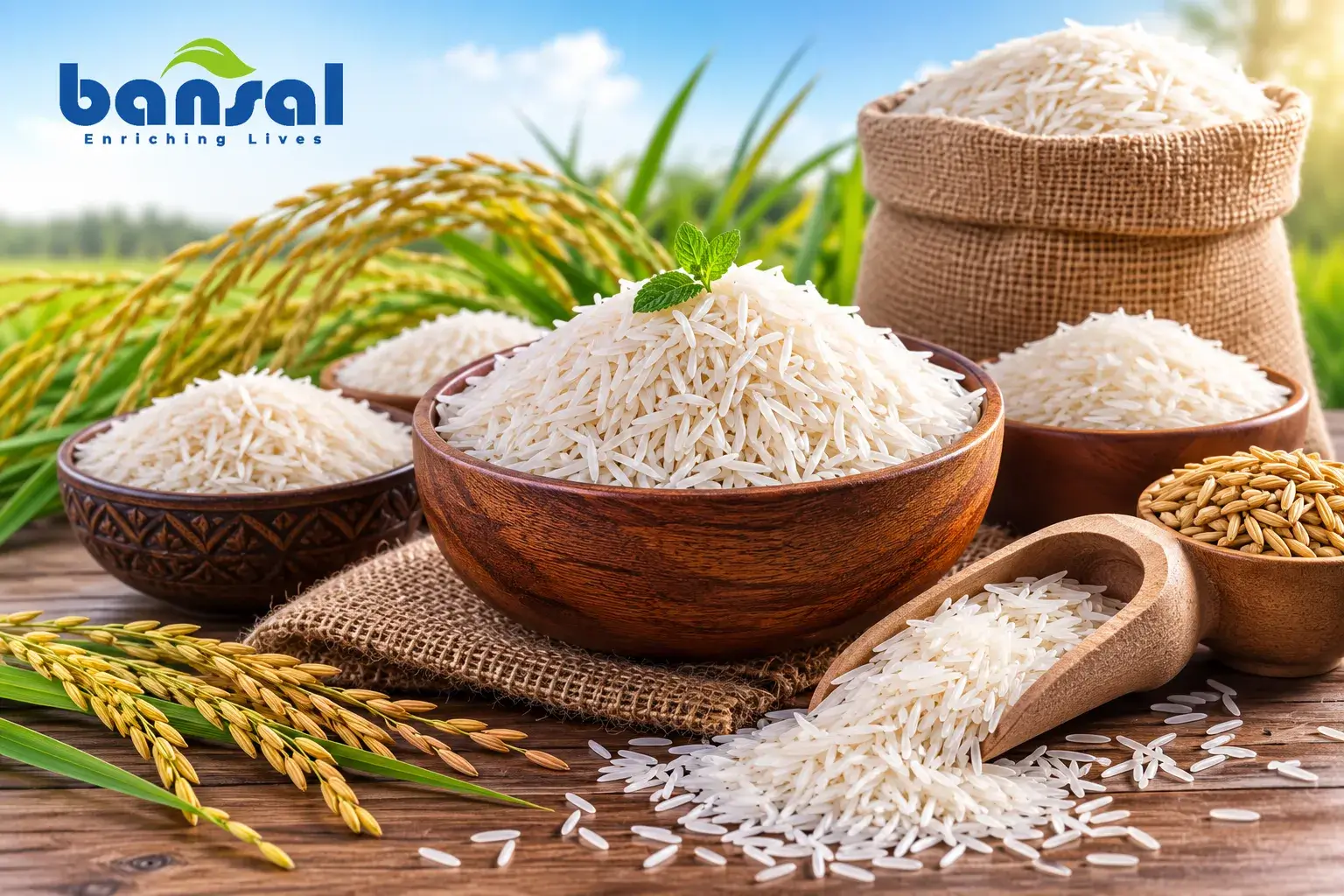
India’s Basmati rice is prized around the world for its long grains, delicate aroma, and fluffy, non-sticky texture after cooking. As a trusted Basmati rice exporter and supplier from India, Bansal FineFoods offers a wide range of Basmati rice varieties, each sourced from the fertile plains of Haryana, Punjab, and Uttar Pradesh and processed to meet strict export-grade standards. Whether you’re a wholesale importer, food service brand, or retail distributor, our Basmati rice portfolio is built to serve global markets with consistency and quality.
Every variety we export goes through the same core process: careful harvesting, natural aging to develop aroma, hygienic milling and polishing, grain grading, and strict quality checks before packing. What differs between varieties is grain length, elongation ratio, maturity cycle, and subtle differences in aroma and texture — and those differences matter a lot depending on whether you’re sourcing for a premium restaurant chain, a retail private label, or a high-volume wholesale contract.
In this post, we walk through each variety in our Basmati rice range — Traditional, 1121, 1509, 1401, 1718, and Pusa — so you can choose the grain that best fits your culinary, retail, or export needs. We’ve also answered some of the most common questions buyers and importers ask us about Basmati rice varieties.
Traditional Basmati Rice
Traditional Basmati Rice represents the authentic, time-honoured taste of Indian Basmati, grown using age-old cultivation methods passed down through generations. Varieties like Basmati 370 and Type-3 fall under this traditional umbrella, and they’re often the benchmark buyers compare newer hybrid varieties against. Known for its classic aroma and naturally long grains, this variety is aged to enhance its fragrance and flavour before it reaches your kitchen. Traditional Basmati typically has a slightly lower yield than hybrid varieties like 1121 or 1509, which is part of why it commands a premium position in the market — production volumes are naturally more limited, and the grain quality is prized precisely because it hasn’t been bred for higher output.
It’s a preferred choice among Basmati rice exporters supplying traditional cuisines, biryani houses, and premium retail brands that want an authentic, unblended grain with a genuine legacy behind it. Chefs working with regional and Mughlai cuisine often specify Traditional Basmati by name because of its distinct fragrance profile, which is subtly different from the newer hybrid varieties. As a Basmati rice manufacturer in India, Bansal FineFoods processes Traditional Basmati Rice under strict hygiene and quality checks, making it export-ready for bulk buyers, importers, and distributors seeking a genuine, aromatic long-grain rice at scale, whether for retail packaging or food service supply contracts.
1121 Basmati Rice
1121 Basmati Rice is one of the most sought-after Basmati varieties globally, celebrated for its extra-long grains and delicate fragrance. Developed through selective breeding and released for commercial cultivation in the early 2000s, 1121 quickly became the benchmark for export-quality long-grain rice, largely grown across Punjab, Haryana, and western Uttar Pradesh. Its raw grain length runs close to 8.3–8.4mm, and on cooking it can elongate to nearly double its size — a trait that’s hard to match among other Basmati varieties and one of the biggest reasons chefs and importers ask for it by name.
Known for exceptional elongation after cooking, 1121 Basmati Rice offers a light, fluffy texture that suits biryanis, pulao, and gourmet rice dishes where presentation matters as much as taste. It’s available across multiple processing types — White, Steam, Sella (parboiled), and Golden Sella — giving buyers flexibility depending on their market’s preference. As a leading 1121 Basmati rice exporter and supplier, Bansal FineFoods carefully grades and processes each batch to meet international export standards, ensuring consistent grain length and aroma across every shipment. This variety is a favourite among wholesale buyers and food service brands looking for a premium, long-grain rice that delivers both visual appeal and superior culinary performance in global kitchens, particularly across Middle Eastern, European, and North American markets.
1509 Basmati Rice
1509 Basmati Rice is an early-maturing Basmati variety known for its fluffy texture, mild aroma, and reliable cooking consistency. Released after 1121, it was developed as a hybrid with a shorter crop cycle and lower water requirement, which makes it more efficient to cultivate while still delivering the long-grain, aromatic qualities buyers expect from Basmati rice. Its grain is slightly broader and marginally shorter than 1121 in its raw form, but it still elongates impressively on cooking and holds its shape well, which is why it’s sometimes referred to as a premium Basmati variety in its own right.
It’s a practical choice for buyers who need efficient, large-volume supply without compromising on the signature qualities of Basmati rice, and its earlier maturity and better yield per acre typically make it a more cost-effective option than 1121 for high-volume contracts. Bansal FineFoods processes 1509 Basmati Rice to export-grade specifications, making it suitable for retail packaging, food service use, and bulk wholesale distribution. Its non-sticky, separate grains after cooking make 1509 Basmati Rice a versatile option for everyday meals as well as commercial kitchens. As a trusted Basmati rice supplier from India, we ensure every batch of 1509 Basmati Rice meets strict hygiene, aging, and grading standards before export.
1401 Basmati Rice
1401 Basmati Rice is an improved, early-maturing hybrid Basmati variety grown across Haryana, Punjab, and Uttar Pradesh, with an average grain length of around 7.3mm to 7.75mm and an elongation ratio of roughly 2.5 times on cooking. As one of the first early-maturing Basmati varieties developed, it gives growers a shorter cultivation cycle while still delivering the aromatic, long-grain qualities that define genuine Basmati rice, which is part of why it remains popular with buyers looking for consistent supply timelines.
It offers a pearl-white, polished grain with a captivating aroma and a delicate, subtly nutty flavour with a hint of sweetness that pairs well with biryanis, pilafs, and stir-fried rice dishes. When cooked, 1401 Basmati Rice grains stay separate and distinct rather than clumping together, giving it a tender bite and pleasant mouthfeel that suits both home-style cooking and commercial food service menus. Its fluffy, non-sticky texture after cooking makes 1401 Basmati Rice a dependable choice for both retail and bulk food service use. Bansal FineFoods supplies 1401 Basmati Rice to global importers and distributors as part of our export-grade Basmati rice range, backed by rigorous quality control at every stage, from sourcing through to final packing.
1718 Basmati Rice
1718 Basmati Rice is valued for its distinct flavour, long grain structure, and improved crop resilience, offering a quality profile close to traditional Basmati types. Developed as a genetic improvement over 1121, it was bred with a focus on resistance to bacterial blight, a disease that can significantly impact rice yield, without compromising on the grain length and aroma buyers expect. In terms of raw grain length, 1718 sits close to 1509 at around 8.4mm, giving it a strong visual profile once cooked and elongated.
It’s an ideal variety for buyers seeking a high-yield, dependable Basmati option that still delivers the aroma and texture expected from premium Indian rice, making it a practical middle ground between the ultra-premium 1121 and more budget-friendly varieties. As a Basmati rice exporter and manufacturer, Bansal FineFoods processes 1718 Basmati Rice with careful grading and hygienic handling, making it export-ready for global cuisines, retail shelves, and food service supply chains. Its consistent grain quality and perfect texture make 1718 Basmati Rice a strong choice for wholesale buyers looking for reliable bulk Basmati rice supply with fewer crop-related disruptions.
Pusa Basmati Rice
Pusa Basmati Rice brings together tradition and innovation, offering a modern, versatile Basmati variety with long grains, reliable cooking behaviour, and a pleasant aroma. It’s worth noting that “Pusa” is actually the research institute (IARI, Pusa) behind several Basmati hybrids, including 1121 and 1509, so the name itself often gets used loosely across the trade — but as a standalone variety, Pusa Basmati Rice is widely accepted for its balance of grain quality, disease resistance, and reliable cooking characteristics.
Widely accepted across international markets, Pusa Basmati Rice suits a broad range of cuisines, from classic Indian dishes to global rice-based recipes, and it’s often chosen by buyers who want dependable Basmati quality without paying a premium reserved for the longest-grain varieties. Bansal FineFoods sources and processes Pusa Basmati Rice to export-grade standards, ensuring hygienic handling, proper aging, and consistent grain quality across every batch. For importers and distributors seeking a Basmati variety that balances authenticity with practicality for large-scale supply, Pusa Basmati Rice is a well-rounded, dependable choice from our Basmati rice product range.
How to Choose the Right Basmati Rice Variety
With six varieties to choose from, buyers often ask us where to start. Here’s a quick way to think about it:
• For the longest grain and strongest aroma: 1121 Basmati Rice is the benchmark, ideal for premium biryani houses, five-star hotels, and export markets like the UAE and Saudi Arabia where presentation matters.
• For a cost-efficient alternative with good elongation: 1509 Basmati Rice delivers strong value for high-volume contracts.
• For an early-maturing, dependable everyday grain: 1401 Basmati Rice works well for both retail packs and food service.
• For crop resilience without losing grain quality: 1718 Basmati Rice is a strong, steady middle-ground option.
• For an authentic, legacy grain: Traditional Basmati Rice suits brands built around heritage and provenance.
• For a balanced, versatile everyday choice: Pusa Basmati Rice fits general-purpose retail and food service needs.
Frequently Asked Questions
What is the difference between 1121 and 1509 Basmati Rice? 1121 has a slightly longer raw grain and a stronger, more pronounced aroma, and it elongates further on cooking, which is why it’s often positioned as the more premium of the two. 1509 has a marginally broader, shorter grain, matures faster in the field, and needs less water to grow, which usually makes it a more cost-effective option for buyers who still want a genuine long-grain Basmati experience.
Which Basmati rice variety is best for biryani? 1121 Basmati Rice is generally the top choice for biryani because of its exceptional elongation and light, fluffy texture, which helps each grain stay separate and visually appealing in the dish. 1509 and 1718 are also commonly used as more budget-conscious alternatives that still hold up well in layered rice preparations.
What does the “1121” or “1509” number in Basmati rice actually mean? These numbers are varietal codes assigned during the research and development process by Indian agricultural research bodies, rather than a grade or quality rating. They simply identify the specific hybrid or cultivar, similar to how a car model number identifies a specific version of a vehicle.
Is 1401 Basmati Rice the same quality as 1121? Not exactly — 1401 has a shorter average grain length than 1121 and a slightly different flavour profile, with a subtle nutty note. It’s considered a strong everyday and food-service grade Basmati rather than the ultra-premium positioning that 1121 typically holds.
What makes Traditional Basmati Rice different from hybrid varieties like 1121 or 1509? Traditional Basmati varieties are grown using older, non-hybridised cultivation methods and tend to have lower yields, which keeps supply more limited. Many buyers choose Traditional Basmati specifically for its classic, unblended flavour and the heritage appeal it brings to a menu or retail product.
Why does aging matter for Basmati rice? Basmati rice is typically aged for one to two years after harvest before milling and export. This aging process reduces moisture content, strengthens the grain, and enhances the natural aroma and elongation on cooking, all of which are qualities that fresh, unaged rice doesn’t fully develop.
What is the ideal rice-to-water ratio for cooking Basmati rice? As a general guide, most Basmati varieties cook well with 1.5 to 2 cups of water per cup of rice, adjusted slightly depending on whether you prefer softer or firmer grains. Rinsing the rice beforehand to remove excess surface starch also helps keep the grains separate and non-sticky.
Is Basmati rice gluten-free and suitable for a low-fat diet? Yes, Basmati rice is naturally gluten-free, making it suitable for people avoiding gluten, and it’s also a low-fat, low-cholesterol grain that provides sustained energy along with carbohydrates and trace nutrients like fibre and B vitamins.
Which Basmati rice variety is exported the most from India? 1121 Basmati Rice remains one of the most widely exported varieties globally, largely due to its grain length and aroma, followed closely by 1509 and 1401, which offer strong value for high-volume international orders.
Why Choose Bansal FineFoods as Your Basmati Rice Exporter
Across all six varieties, Bansal FineFoods maintains the same commitment: hygienically processed, aged, and graded Basmati rice that meets international quality benchmarks. Whether you need Traditional, 1121, 1509, 1401, 1718, or Pusa Basmati Rice, our team supports global importers, distributors, and wholesale markets with reliable sourcing and scalable bulk supply.
Explore our full Basmati rice product range or get in touch with our team to discuss bulk export requirements for your market.