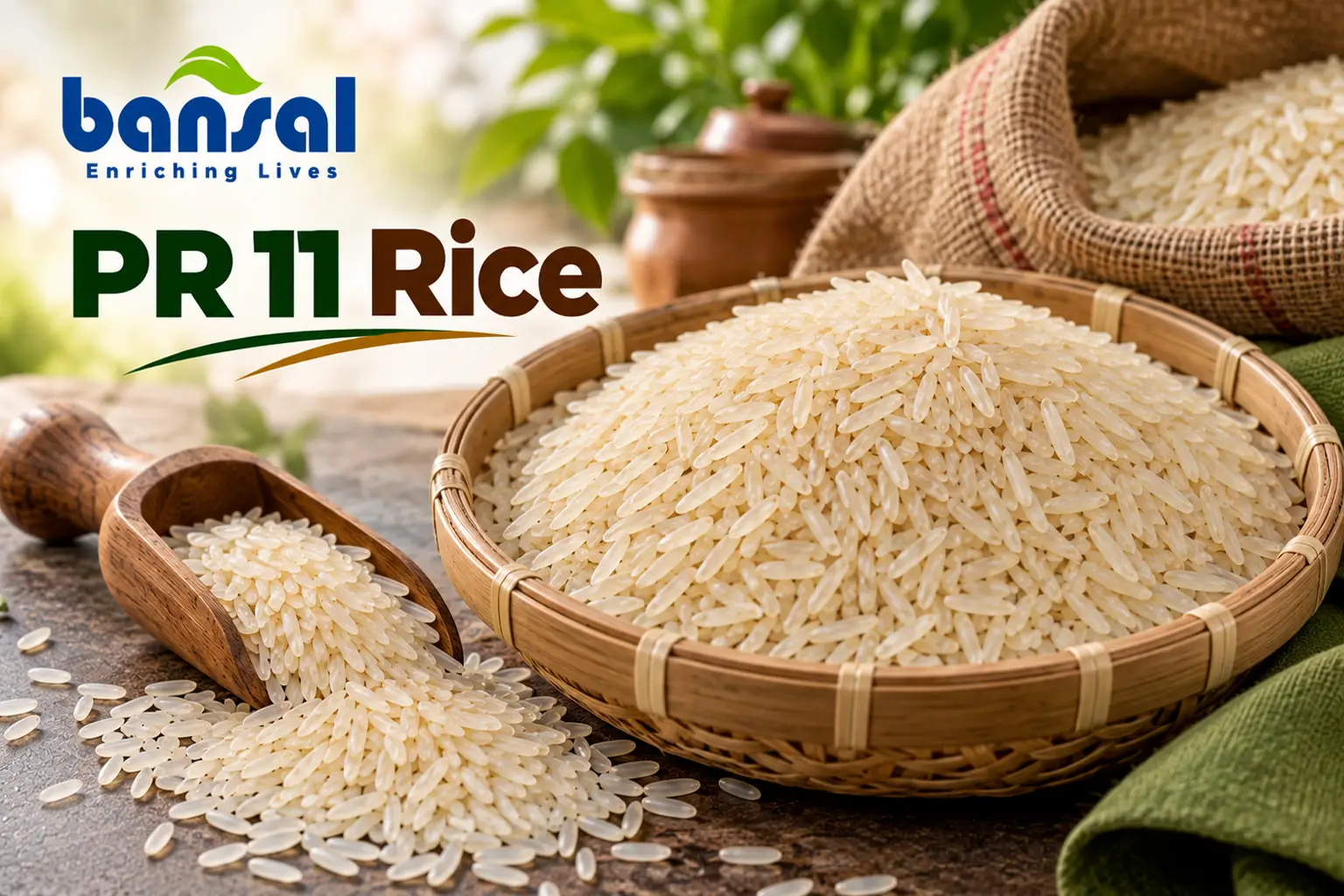
Some rice varieties build their reputation on aroma or grain length. PR11 builds its reputation on something buyers in bulk and institutional markets value just as much: dependability. It’s a variety that consistently delivers on the basics — good grain quality, stable cooking behavior, and pricing that supports high-volume purchasing — without asking buyers to pay for characteristics they don’t need.
PR11 is part of Bansal FineFoods’ non-basmati portfolio, available through our non-basmati rice exporter and supplier range alongside Sugandha, Sharbati, RH10, PR106, and IR64. Here’s what buyers should know before sourcing it.
What Is PR11 Rice?
PR11 is a long-grain, non-basmati rice variety developed by Punjab Agricultural University and widely cultivated across Punjab and Haryana. It belongs to the same broader family of high-yield, government-supply-oriented rice varieties as PR14, PR26, and PR106, all bred with a strong emphasis on consistent yield and grain quality suited to large-scale catering, government procurement, and bulk commercial buyers.
Grain-wise, PR11 shares meaningful similarities with IR64 in terms of overall profile and market positioning, though buyers who work with both varieties regularly can distinguish them by subtle differences in grain length and cooking texture. Both are workhorse varieties built for volume rather than aromatic distinction.
Key Characteristics of PR11 Rice
Grain structure — long grains with a clean, consistent appearance that holds up well through milling and bulk processing, a key requirement for the institutional and government-supply buyers who form much of PR11’s core market.
Cooking behavior — fluffs up predictably with minimal breakage, giving kitchens and food processors reliable results across large batch sizes without the guesswork that comes with more variable varieties.
Yield and availability — as a high-yield variety cultivated extensively across Punjab and Haryana, PR11 benefits from stable, large-volume supply, which supports more predictable pricing for buyers with continuous procurement needs.
Value positioning — priced firmly in the accessible, bulk-commodity tier, making it a practical choice for buyers whose priority is cost-per-kilo consistency rather than aromatic character or premium grain length.
Why Institutional and Government-Supply Buyers Favor PR11
PR11’s core market — large-scale catering operations, government food distribution programs, hostels, and institutional kitchens — has very specific priorities: consistent quality across enormous volumes, predictable pricing, and rice that performs reliably regardless of who’s cooking it or how large the batch is. PR11 checks all three boxes without the price premium that comes with aromatic or extra-long-grain varieties.
This has made it a staple choice for procurement teams managing large recurring orders, where even small quality inconsistencies, multiplied across thousands of servings, create real operational headaches. PR11’s track record for uniform behavior at scale is precisely why it keeps winning repeat institutional contracts.
Common Uses for PR11 Rice
- Government and institutional food supply programs — a standard choice for large-scale, cost-controlled procurement
- Bulk catering and hostel kitchens — dependable cooking behavior across high-volume batch preparation
- Food processing — consistent grain structure supports predictable outcomes in industrial rice processing
- Value-tier retail and wholesale distribution — a practical option where cost efficiency drives purchasing decisions
Cultivation Background and Regional Availability
PR11 belongs to a lineage of PR-series varieties developed specifically for the growing conditions and agricultural infrastructure of Punjab and Haryana — states that together account for a substantial share of India’s total rice production and export volume. This regional concentration works in buyers’ favor: established irrigation systems, experienced growers, and mature milling infrastructure all contribute to consistent year-on-year supply, which is precisely what large institutional and government-supply buyers need from a bulk commodity variety.
Because PR11 and its sister varieties are bred with government and institutional procurement programs specifically in mind, cultivation practices and quality benchmarks tend to be well standardized across growing regions — a meaningful advantage for buyers who need predictable specifications across multiple sourcing points or growing seasons.
Procurement Patterns Among Large-Volume Buyers
Buyers who purchase PR11 at scale — state food distribution agencies, large catering contractors, hostel and institutional kitchen networks — tend to operate with very different procurement rhythms than retail-focused buyers. Orders are typically larger, contracts often span full growing seasons or years rather than single shipments, and pricing negotiations frequently hinge on guaranteed volume commitments rather than spot-market rates.
For suppliers, this means PR11 sourcing relationships often look less like transactional purchases and more like ongoing supply partnerships, with quality consistency across an entire contract period mattering more than any single batch. Buyers evaluating new PR11 suppliers should factor this into their vetting process — asking not just about current stock quality, but about a supplier’s track record for maintaining consistency across long-term, high-volume contracts.
Structuring Long-Term PR11 Supply Contracts
Given that so much of PR11’s demand comes from institutional and government-linked buyers operating on annual or multi-season contracts, it’s worth understanding what separates a well-structured supply agreement from a risky one. Contracts that specify only price and volume, without locking in quality benchmarks like moisture content ceilings and broken grain percentage limits, leave buyers exposed to quality drift over the life of the contract — a real risk when a supplier is under pressure to fulfill large volume commitments across an entire season.
Buyers negotiating standing PR11 orders should push for contract language that ties pricing to specific, testable quality benchmarks, with agreed remediation steps if a delivered batch falls outside those parameters. It’s a more rigorous approach than many smaller buyers are used to, but for the volumes typically involved in PR11 procurement, the additional contractual precision pays for itself many times over if it prevents even a single problematic bulk delivery.
What to Check Before Sourcing PR11 Rice
- Grain length and consistency documentation — request lab-tested specifications, particularly if PR11 will be used alongside or compared against IR64 in your product line.
- Moisture content — verify it falls within export-safe limits to avoid spoilage risk, especially important for large bulk shipments held in storage for extended periods.
- Broken grain percentage — should be clearly documented, since bulk buyers often negotiate pricing partly on this specification.
- Supply volume commitments — confirm your supplier can support the continuous, high-volume ordering patterns typical of institutional buyers.
- Sample cooking trial — test before committing to large orders, particularly for buyers transitioning from a different bulk variety.
Storage and Handling Recommendations
- Store below 25°C in a dry, ventilated warehouse environment, standard practice for any bulk rice held in large-volume storage.
- Implement strict first-in, first-out rotation, especially important given the high-volume nature of PR11’s typical buyer base.
- Monitor for pest activity proactively during extended bulk storage periods common in institutional and government supply chains.
- Protect packaging integrity during handling, since bulk shipments are more prone to transit damage than smaller retail-format orders.
Why Buyers Choose Bansal FineFoods for PR11 Rice
We supply PR11 with the grading discipline that institutional and bulk buyers depend on — documented moisture content, broken grain percentage, and consistent quality across large recurring orders. Our team works directly with government-supply contractors, catering operations, and wholesale distributors to structure standing orders that keep pace with continuous procurement needs.
PR11 Compared to Other Non-Basmati Varieties
Against IR64, PR11 shares a broadly similar market position, with subtle differences in grain profile that experienced buyers can distinguish through direct comparison. Compared to PR106, PR11 and its sister variety serve very similar institutional and bulk markets, often selected based on regional availability and specific procurement requirements. Against aromatic options like RH10 or Sugandha and Sharbati, PR11 trades fragrance for cost efficiency and supply reliability at scale.
A Dependable Foundation for High-Volume Procurement
For buyers whose core need is dependable, high-volume rice supply rather than aromatic distinction, PR11 remains one of the most reliable choices in the non-basmati category. Its track record with institutional and government buyers reflects exactly what large-scale procurement needs: consistency, availability, and pricing that supports sustainable purchasing at scale, season after season.
Frequently Asked Questions
What is PR11 rice used for?
PR11 is widely used in government food supply programs, institutional catering, hostel kitchens, and bulk wholesale distribution, where consistent quality and cost efficiency at high volumes matter more than aromatic character.
How does PR11 rice compare to IR64?
The two varieties share a broadly similar market position and are both bred for high yield and consistent bulk performance, though experienced buyers can distinguish subtle differences in grain length and cooking texture between them.
Is PR11 rice suitable for export?
Yes, PR11 is commonly exported for bulk institutional and commercial use, particularly to markets with demand for affordable, dependable long-grain rice at scale.
What should I check before placing a bulk order of PR11 rice?
Request documentation on grain length, moisture content, and broken grain percentage, and confirm your supplier can support continuous high-volume ordering if you’re purchasing for institutional or government-supply purposes.
Does Bansal FineFoods supply PR11 rice for large-volume institutional contracts?
Yes, we support standing orders and bulk export for PR11 with consistent grading documentation. Explore our full range on our non-basmati rice exporter and supplier page.