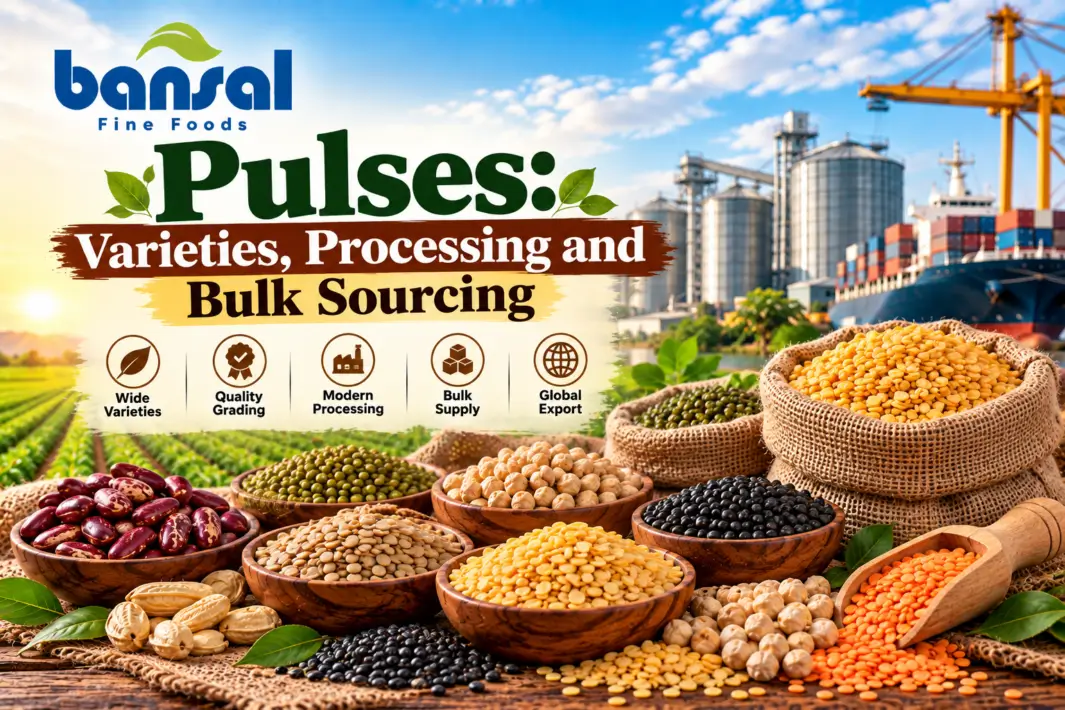
Walk into any Indian kitchen and you will find at least one jar of dal. From a simple tadka dal to a slow-cooked rajma or a plate of chana masala, pulses sit at the centre of everyday Indian meals. They are also a global staple, valued as an affordable source of plant protein and fibre in homes, restaurants and food businesses around the world.
India is one of the largest producers and consumers of pulses, which makes it a natural base for buyers looking for a dependable pulses manufacturer, pulses exporter or pulses supplier. But with so many pulses suppliers in the market, how do you separate a reliable partner from an average one? The answer lies in sourcing, processing, grading, packaging and the consistency of every lot delivered.
Bansal Fine Foods supplies a wide range of pulses to wholesalers, retailers, food businesses and importers. This blog explains the major pulse varieties, how pulses are processed, what to look for in a pulses supplier in India, and how bulk and export orders are typically handled.
What Are Pulses?
Pulses are the dry, edible seeds of leguminous plants. They include lentils, dried peas, beans and chickpeas. In everyday Indian usage, “dal” usually refers to pulses that have been split and husked, while “whole” pulses retain their outer skin.
Pulses matter for several reasons. They are naturally rich in protein and dietary fibre, low in fat and contain useful minerals such as iron, folate and potassium. They are also gluten-free and have a long shelf life when stored properly, which makes them practical for both households and large-scale food supply.
Why Demand for Pulses Keeps Rising
Plant-based eating. More consumers are looking for vegetarian and plant-based protein sources, and pulses are the most accessible option.
Everyday staple. In India, pulses appear in daily meals across regions, which creates steady, year-round demand.
Food processing. Pulses and their flours are used in snacks, namkeen, sweets, ready mixes, batters and packaged foods.
Export markets. Communities and cuisines around the world rely on Indian-style pulses, creating consistent demand for dependable exporters.
Affordability and shelf life. Pulses offer good nutrition at a reasonable price and store well, which suits retail, institutional kitchens and bulk buyers alike.
Popular Pulses We Supply
Toor Dal (Arhar Dal)
Toor dal is the base of sambar, dal tadka and countless household meals. It is yellow, mildly earthy and cooks into a creamy, thick dal. It is supplied in polished and unpolished forms, and buyers usually compare it on grain size, colour uniformity and cooking time. Its steady demand makes it one of the most traded pulses in the country.
Moong Dal
Moong dal comes in whole green (sabut moong), split with skin (chilka) and split yellow (dhuli moong dal). It is light, quick to cook and easy to digest, which is why it features in khichdi, soups, chilla and sweets like halwa. Yellow moong dal is a favourite for everyday cooking, and whole moong is popular for sprouting.
Chana Dal and Kabuli Chana
Chana dal is split Bengal gram with a nutty flavour and firm bite, used in dals, snacks, sweets and flour (besan). Kabuli chana, the large cream-coloured chickpea, is used in chole, salads and hummus-style preparations. Size, colour and uniformity are the main quality markers for kabuli chana.
Masoor Dal
Masoor dal is the small orange-red lentil that cooks quickly without much soaking. Whole masoor is brown with a distinct earthy flavour. It is widely used in home cooking and food service because of its speed, affordability and good taste.
Urad Dal
Urad dal is available whole black, split with skin and split white (dhuli). It is essential for dosa and idli batter, dal makhani, papad and vadas. Buyers usually check for uniform colour, clean grain and low broken content.
Rajma and Other Beans
Rajma (kidney beans) is a North Indian favourite, prized for its rich texture in rajma-chawal. Other pulses such as lobia (black-eyed peas), green peas and matar are also in demand.
Availability of individual pulses and grades can vary with the season and crop. Contact our team to confirm what is currently available for your requirement.
From Farm to Pack: How Pulses Are Processed
Good pulses are not just harvested. They are cleaned, processed and graded before they reach your kitchen or warehouse. A capable pulses manufacturer typically manages these steps.
Cleaning. Raw pulses contain stones, dust, husk and foreign seeds. Cleaning machines remove these impurities.
Grading and sizing. Pulses are sorted by size and quality so each lot is uniform.
Dehusking and splitting. Whole pulses are dehusked and split to make dals like toor, moong and masoor.
Polishing. Some dals are polished for a cleaner, brighter look. Unpolished dals keep their natural finish, and many buyers prefer them for that reason.
Colour sorting. Optical sorters remove discoloured, damaged or off-colour grains for a clean, consistent product.
Moisture control. Correct moisture levels prevent mould, spoilage and insect infestation during storage and transport.
Packing. Finished pulses are packed in retail pouches, bags or bulk packaging, depending on the buyer’s requirement.
Working with a supplier that controls these steps means better consistency from one lot to the next.
Polished vs Unpolished Pulses
This is one of the most common questions buyers ask.
Polished pulses are processed to give a smoother, brighter finish and a uniform appearance. They are popular in retail packs where appearance matters.
Unpolished pulses retain their natural surface and are often preferred by consumers who want minimal processing. Some buyers believe they retain more of the grain’s natural character, though both types are widely consumed.
The right choice depends on your market and customers. A good pulses supplier should be able to offer both and explain the difference clearly.
What Makes a Reliable Pulses Supplier in India?
The pulses trade involves large volumes and tight margins, so reliability counts for a lot. Here is what to look for in pulses suppliers.
Consistent quality. The lot you receive should match the sample you approved. Colour, size, cleanliness and cooking quality should be the same on every order.
Clear specifications. Variety, grade, moisture, foreign matter, damaged grains and packaging should be stated in writing before you place an order.
Proper sourcing. A dependable supplier sources from trusted growing regions and can explain where and how the produce is procured.
Hygienic processing and storage. Clean facilities, dry storage and pest control protect pulses from spoilage and infestation.
Flexible order sizes. Whether you need a trial lot or regular bulk supply, the supplier should be able to work with your volumes.
Timely delivery. Reliable dispatch and clear communication keep your stock and sales on track.
Fair, transparent pricing. Good suppliers explain price differences between grades and do not hide quality trade-offs behind low quotes.
Understanding the Difference: Manufacturer, Supplier and Exporter
These terms are often used interchangeably, but they describe different roles.
A pulses manufacturer processes raw pulses through cleaning, splitting, polishing, sorting and packing. Manufacturing capability gives control over quality and specification.
A pulses supplier delivers pulses to wholesalers, retailers, hotels, caterers and food companies, usually across domestic markets. Strong logistics and consistent availability define a good supplier.
A pulses exporter takes pulses to international buyers, handling export documentation, packaging for long transit and coordination of shipping.
When one company combines all three roles, buyers benefit from a single point of accountability, from processing to delivery.
Pulses Export: What Importers Should Expect
Buying pulses from India for an overseas market involves more steps than a domestic purchase. A capable pulses exporter helps you manage them.
Specification and sampling. Variety, grade, size, moisture and packaging are agreed first. Importers normally approve a sample before a bulk shipment is prepared.
Documentation. Export shipments typically require a commercial invoice, packing list, bill of lading, certificate of origin and phytosanitary certificate. Some destinations also require a fumigation certificate or certificate of analysis. Importers should confirm requirements with their own customs authorities.
Packaging for transit. Pulses are commonly shipped in food-grade bags, such as 25 kg and 50 kg packs, or in bulk containers, protected against moisture and pests.
Shipping terms. Terms such as FOB, CFR and CIF define responsibility and cost at each stage of the journey. A good exporter explains these clearly.
Policy awareness. India’s rules on pulses trade have changed over time, and export and import conditions for particular pulses can be adjusted. A responsible exporter keeps up with current regulations and flags anything that could affect an order early.
Quality Checks Every Buyer Should Make
Before you commit to a bulk order, check these points on a sample.
- Uniform size and colour. Mixed sizes or patchy colour suggest poor grading.
- Cleanliness. The lot should be free of stones, husk, dust and foreign seeds.
- Low broken and damaged grains. Excess breakage reduces quality and cooking performance.
- No signs of infestation. Holes, webbing or live insects are red flags.
- Fresh smell. Pulses should smell clean, not musty or stale.
- Cooking test. Cook a small portion to check cooking time, softness and taste.
Packaging and Storage of Pulses
Proper packaging protects quality from the warehouse to the kitchen.
- Retail packs in pouches of various sizes for supermarkets and online sellers
- 25 kg and 50 kg bags for wholesale, food service and export
- Bulk packing for large industrial buyers
- Private-label packing with your own brand and design
At home or in storage, keep pulses in a cool, dry, airtight container away from moisture and direct sunlight. Stored properly, pulses stay fresh for many months.
Why Choose Bansal Fine Foods?
Bansal Fine Foods works across rice and pulses, and our approach to quality carries across every category. When you choose us as your pulses manufacturer, pulses exporter or pulses supplier in India, you can expect:
- A wide range of pulses, from toor, moong and chana to masoor, urad and rajma
- Carefully cleaned, sorted and graded produce for uniform quality
- Both polished and unpolished options where applicable
- Specification-based supply, so what you approve is what you receive
- Flexible order sizes, from trial lots to bulk and export volumes
- Custom and private-label packaging for retail and wholesale buyers
- Export documentation support and shipment coordination for international customers
Whether you are a retailer, wholesaler, restaurant chain, food manufacturer or importer, our team can help you choose the right pulses and grades for your needs.
How to Choose the Right Pulses Supplier for Your Business
- Define your requirement. Decide which pulses, forms (whole or split), grades and volumes you need.
- Request samples. Check size, colour, cleanliness and cooking quality before ordering in bulk.
- Review the specification sheet. Confirm moisture, foreign matter, broken grains and packaging in writing.
- Ask about processing. Understand how the pulses are cleaned, sorted and stored.
- Compare total value. The lowest price is not always the best deal if quality varies between lots.
- Begin with a trial order. It shows how the supplier handles quality, packing and delivery.
Frequently Asked Questions About Buying Pulses in Bulk
1. What is the difference between dal and pulses?
Pulses are the dry edible seeds of legume crops. Dal usually refers to pulses that have been dehusked and split, such as toor dal or moong dal.
2. Which pulses are most in demand?
Toor dal, moong dal, chana dal, masoor dal, urad dal, kabuli chana and rajma are among the most commonly bought pulses in India and in export markets.
3. What is the minimum order quantity for pulses?
It varies by pulse, grade and packaging. Both trial and bulk orders are common. Contact our team with your requirement for exact quantities and terms.
4. Can I get samples before placing a bulk order?
Sampling is standard practice in the pulses trade. Buyers typically approve a sample against the agreed specification before confirming a larger order.
5. Are polished pulses better than unpolished ones?
Neither is better in every case. Polished pulses have a brighter, uniform look, while unpolished pulses keep their natural finish. The choice depends on your customers’ preferences.
6. What documents are needed to export pulses from India?
Typically a commercial invoice, packing list, bill of lading, certificate of origin and phytosanitary certificate, plus any additional certificates the destination country requires.
7. How should pulses be stored to stay fresh?
Keep them in a cool, dry, airtight container away from humidity and sunlight. Periodic checks help catch any moisture or pest issues early.
8. Do you offer private-label packaging for pulses?
Custom and private-label packing can be discussed depending on the pulse, pack size and order volume.
Conclusion
Pulses are among the most important foods in India and a growing part of the global food trade. Getting the best result depends on choosing the right variety, the right grade and the right partner, one that is consistent, transparent and dependable.
Bansal Fine Foods combines careful sourcing, quality-focused processing and export support to deliver pulses that meet your specifications every time. Explore our range of pulses and contact Bansal Fine Foods today for samples, pricing and bulk or export enquiries.