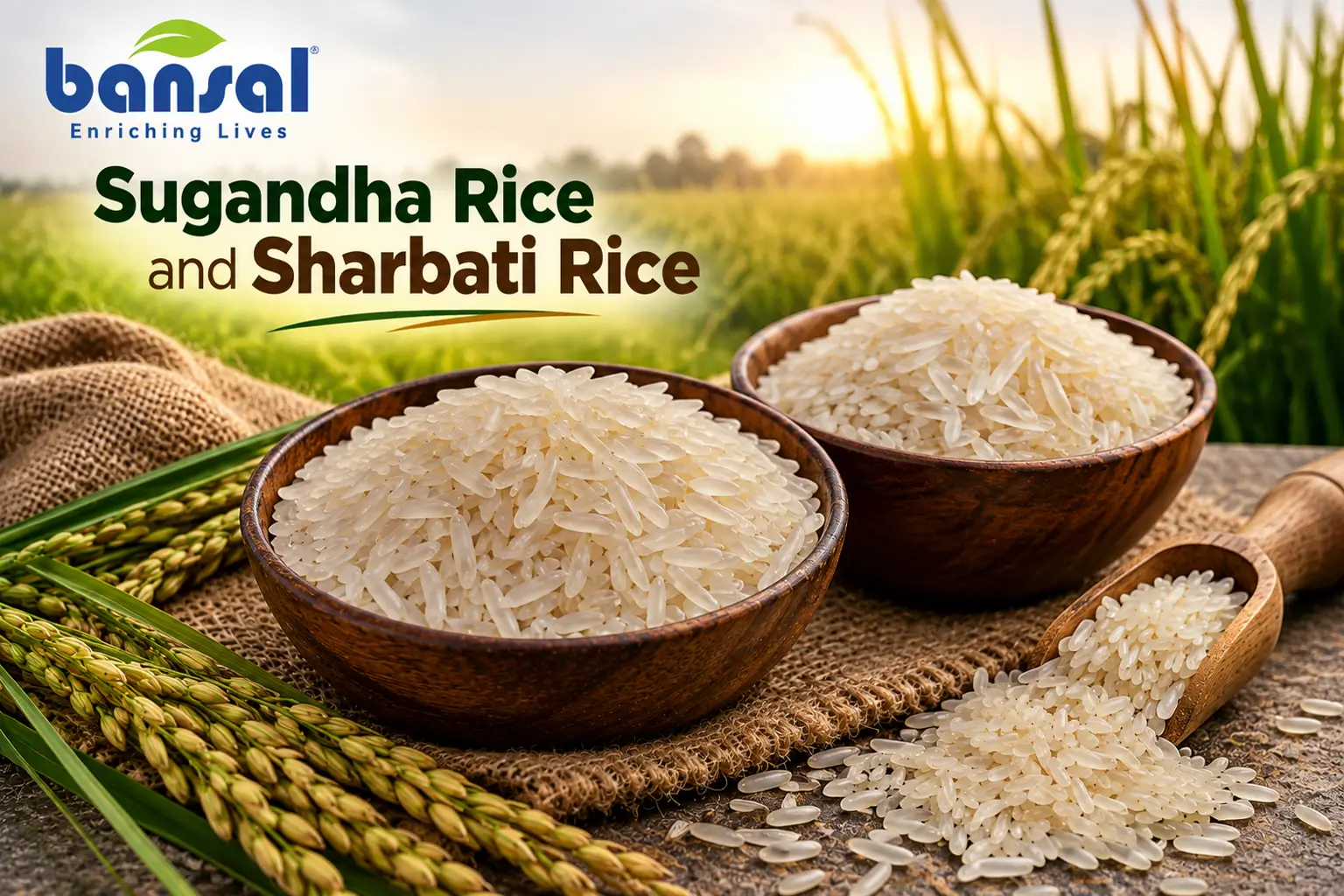
Not every buyer sourcing aromatic rice needs, or wants to pay for, the extra-long grain and premium pricing of top-tier basmati. A large and growing segment of the market — retailers, food service operators, and household consumers alike — is looking for something in between: rice with genuine fragrance and good cooking quality, priced for everyday use rather than special occasions. That’s exactly the space Sugandha and Sharbati rice occupy.
Both varieties are part of Bansal FineFoods’ export range, available through our non-basmati rice exporter and supplier portfolio alongside RH10, PR11, PR106, and IR64. This post covers what makes each variety distinct, where they fit in a sourcing strategy, and what to check before ordering in bulk.
What Is Sugandha Rice?
Sugandha rice is a long-grain aromatic variety grown primarily in Haryana, Punjab, and parts of Uttar Pradesh. The name itself means “fragrance” in Hindi, and that’s the variety’s core selling point — a genuine, sweet, floral aroma that intensifies on cooking, close enough to basmati’s signature scent that many buyers use Sugandha as a direct, more affordable substitute in everyday cooking applications.
Grain-wise, Sugandha is long and slender, though typically a touch shorter than premium basmati varieties like 1121 or 1509. It still elongates meaningfully when cooked — often close to double its raw length — and the grains stay separate and non-sticky, which keeps it useful across a wide range of rice dishes rather than being limited to a single culinary application.
What Is Sharbati Rice?
Sharbati rice comes primarily from Madhya Pradesh and parts of Rajasthan, and it tells a slightly different story than Sugandha. Where Sugandha leans on aroma as its main differentiator, Sharbati is prized more for its attractive golden color, mild fragrance, and notably affordable pricing. It’s a long-grain, non-sticky rice that cooks up light and fluffy, and it has built a loyal following among households that want good everyday rice without paying an aromatic-variety premium.
Sharbati also has a reputation for being easy on the digestive system, with a fiber profile that many buyers in the health-conscious retail segment find appealing when positioning it alongside other everyday grain products.
Key Characteristics Compared
Aroma — Sugandha rice offers a distinct, sweet, floral fragrance, the closest of the two to true basmati. Sharbati rice has a milder, more subtle fragrance.
Grain length — Sugandha grains are long and slender. Sharbati grains are also long, but slightly shorter and rounder in comparison.
Color — Sugandha typically shows an off-white hue, while Sharbati is known for its attractive golden-white color.
Price positioning — Sugandha sits in the mid-tier, basmati-adjacent price bracket. Sharbati is positioned as a highly affordable everyday option.
Best suited for — Sugandha works well for biryani, pulao, and everyday aromatic cooking. Sharbati is best suited to daily meals and bulk, value-tier packaging.
Both varieties share one important trait that matters for export buyers: consistent, dependable cooking behavior across large batch sizes, which makes portion planning and recipe standardization straightforward for institutional kitchens and food processors.
Why Buyers Choose Sugandha and Sharbati Over Basmati
The honest answer is price-to-quality ratio. A buyer supplying a mid-market retail chain, a catering operation, or a quick-service restaurant often doesn’t need the extra-long grain and premium fragrance of 1121 basmati — they need rice that tastes good, looks reasonably appealing on the plate, and keeps their cost per kilo manageable. Sugandha and Sharbati both deliver on that brief without asking buyers to compromise on the basic promise of aromatic, non-sticky, well-separated grains.
This has made both varieties increasingly popular in export markets with large South Asian diaspora populations, where demand for “basmati-style” rice at accessible pricing has grown steadily — buyers who might not stretch to premium basmati for daily cooking are a natural audience for Sugandha or Sharbati instead.
Common Applications
- Everyday biryani and pulao where full basmati aroma isn’t essential
- Retail packaging positioned as an affordable aromatic option
- Food service and catering where cost control matters alongside flavor
- Blending with basmati to extend volume while retaining aromatic character
- Daily household cooking and staple meal preparation
- Value-tier retail and bulk institutional supply
- Health-conscious positioning, given its digestibility and fiber content
- Government and large-scale catering programs where cost efficiency is the primary driver
Grading, Packaging, and Export Logistics
Export-grade Sugandha and Sharbati rice are typically sorted by broken grain percentage and moisture content before packing, with the cleanest lots commanding the strongest pricing. As with any bulk rice purchase, buyers should ask suppliers to be specific about grading terminology rather than accepting generic labels like “premium” or “export quality” without documentation behind them.
Packaging formats generally follow buyer type:
- Bulk PP or jute bags in 25 kg, 50 kg, or 1-tonne formats for wholesale, institutional, and catering buyers
- Retail-ready packs, typically 1 kg to 5 kg, for supermarket and private-label distribution
- Custom branded packaging for buyers building their own retail identity around an affordable aromatic rice line
Moisture control at the point of packing directly affects shelf stability during transit, particularly relevant for Sugandha, whose aromatic compounds are more sensitive to humidity than some non-aromatic bulk varieties. Buyers shipping to markets with long transit times should confirm packing moisture levels explicitly rather than assuming standard practice covers it.
Market Demand for Affordable Aromatic Rice
Demand for both varieties has grown steadily as more markets develop a taste for aromatic rice without the budget to support it at basmati pricing. This is particularly visible in export corridors serving South Asian diaspora communities, where household buyers want the fragrance and texture associated with home cooking traditions, but where premium basmati pricing puts daily use out of reach for many. Sugandha and Sharbati both fill that gap effectively, and suppliers who can document consistent aroma and grain quality across batches tend to build strong repeat-buyer relationships in these markets.
Retailers and food service operators have also increasingly used both varieties to build tiered product lines — offering a genuine aromatic option below their premium basmati SKUs, which widens their addressable customer base without diluting their premium positioning.
Cooking Tips for Sugandha and Sharbati Rice
Buyers building recipe guidance or packaging copy around these varieties often ask how they perform relative to basmati in the kitchen, since that comparison shapes customer expectations. A few practical notes worth passing along to downstream customers or your own product development team:
- Water ratio — both varieties generally cook well at a 1:1.5 to 1:1.75 rice-to-water ratio, similar to standard basmati, though Sharbati’s slightly rounder grain can benefit from a touch less water for a firmer finish.
- Soaking — a 20-30 minute soak before cooking improves elongation and texture for both varieties, though it’s less critical than it is for premium long-grain basmati.
- Resting after cooking — letting the rice rest covered for five to ten minutes after cooking helps grains separate cleanly, particularly useful for Sugandha when used in biryani-style preparations.
- Blending — some buyers blend a portion of premium basmati with Sugandha or Sharbati to lift the aroma of a value-tier product without fully absorbing basmati’s cost, an approach worth discussing with your supplier if margin management is a priority.
What to Check Before Sourcing Sugandha or Sharbati Rice
- Grain length and aroma consistency — request a sample lot and confirm the aroma profile matches what’s been quoted, since aromatic intensity can vary meaningfully between suppliers and harvests.
- Moisture content — verify it sits within safe export limits, generally under 13%, to avoid spoilage risk during transit.
- Broken grain percentage — get this documented in writing rather than accepting a verbal estimate.
- Aging period — both varieties benefit from proper aging for improved texture and aroma, though buyers focused purely on cost sometimes accept shorter aging windows.
- Packaging format — confirm whether you need bulk bags for institutional buyers or retail-ready packaging for direct-to-consumer positioning.
Storage and Handling Recommendations
- Store below 25°C in a dry, well-ventilated space to protect aroma and prevent moisture reabsorption.
- Avoid direct sunlight exposure, which can gradually reduce Sugandha’s signature fragrance over time.
- Rotate stock actively in high-turnover retail settings, since both varieties are typically purchased for regular, high-volume use.
- Reseal packaging promptly after opening to preserve freshness and prevent pest exposure.
Why Buyers Choose Bansal FineFoods for Sugandha and Sharbati Rice
We source and grade both varieties to documented specifications covering grain length, moisture content, and broken percentage, so buyers get consistent quality whether they’re placing a single container order or a standing annual contract. Our team can also advise on blending strategies for buyers looking to combine Sugandha or Sharbati with premium basmati varieties to manage cost without sacrificing aromatic character.
How These Fit Alongside Our Broader Non-Basmati Range
For buyers building a complete non-basmati portfolio, Sugandha and Sharbati typically anchor the aromatic, value-conscious tier, while varieties like RH10, PR11, PR106, and IR64 serve more general-purpose, bulk-volume applications. Understanding where each variety fits helps buyers structure a sourcing program that serves multiple customer segments without overpaying for characteristics a given application doesn’t need.
Building a Value-Tier Aromatic Product Line
For brands and distributors thinking beyond a single purchase, Sugandha and Sharbati together offer a practical way to build out a value-tier aromatic rice line without significant category-building effort — both varieties come with established consumer recognition in their core growing regions, meaning buyers aren’t starting from zero on customer education. Positioning them clearly (Sugandha as the more aromatic, basmati-adjacent option; Sharbati as the affordable, everyday staple) helps avoid customer confusion and supports cleaner merchandising across a retail range.
Frequently Asked Questions
What is the difference between Sugandha and Sharbati rice?
Sugandha rice is a long-grain aromatic variety with a distinct, basmati-like fragrance, grown mainly in Haryana and Punjab. Sharbati rice, grown primarily in Madhya Pradesh, has a milder fragrance and an attractive golden color, and is generally positioned as an even more affordable everyday option.
Is Sugandha rice a good substitute for basmati rice?
Yes, for many everyday applications. It offers a similar long-grain shape and genuine aroma at a more accessible price point, though it typically doesn’t match premium basmati varieties like 1121 in grain length or elongation.
Is Sharbati rice suitable for bulk export?
Yes. Its affordability, mild flavor, and consistent cooking behavior make it a popular choice for institutional buyers, value-tier retail packaging, and large-scale catering programs.
How should Sugandha and Sharbati rice be stored to preserve quality?
Both should be stored below 25°C in a dry, well-ventilated space, away from direct sunlight, with packaging resealed promptly after opening to protect aroma and prevent moisture pickup.
Does Bansal FineFoods supply Sugandha and Sharbati rice for private-label packaging?
Yes, we support private-label and bulk export orders for both varieties with documented grading and quality testing. You can explore our full range on our non-basmati rice exporter and supplier page.