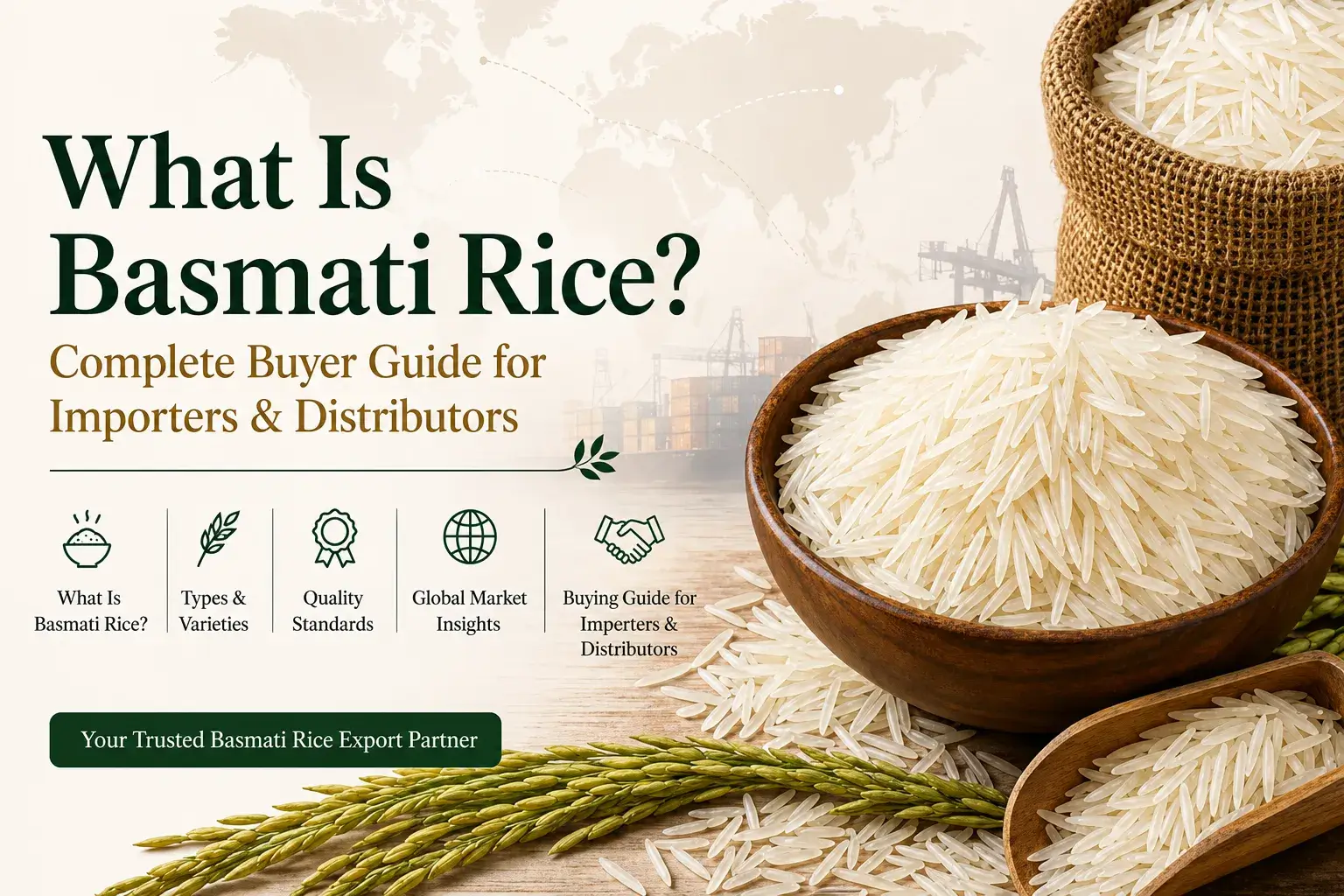
If you are an importer, distributor, or wholesale buyer looking to source basmati rice from India, this guide is for you. Basmati is not a single product — it is a category of premium long-grain aromatic rice with distinct varieties, processing grades, and quality specifications that directly affect what markets it suits and what price it commands.
India accounts for roughly 65–70% of global basmati exports, making it by far the dominant supplier in the world. Within India, the states of Haryana, Punjab, and Uttar Pradesh produce the overwhelming majority of export-grade basmati — and companies like Bansal Fine Foods, operating out of Karnal (Haryana) for over 85 years, sit at the heart of this supply chain.
This guide covers everything an international buyer needs to know: what makes basmati rice unique, the major varieties available, processing types and their impact on shelf life and market suitability, export quality specifications, and key questions to ask a supplier before placing your first bulk order.
1. What Makes Basmati Rice Unique?
The word basmati comes from Sanskrit, loosely translated as “the fragrant one.” It is a long-grain rice variety grown only in a specific geographic region of the Indian subcontinent — primarily in Haryana, Punjab, Uttar Pradesh, and parts of Pakistan. The unique combination of soil, water, and climate in this region is what gives basmati its defining characteristics.
Three characteristics distinguish genuine basmati from other long-grain rice varieties:
| Characteristic | What It Means for Buyers |
|---|---|
| Exceptional grain length | Raw grain length of 7.2–8.45 mm depending on variety. On cooking, grains elongate to 2–3× their original length — a key quality signal for biryani and pilaf markets. |
| Distinctive aroma | Caused naturally by the compound 2-acetyl-1-pyrroline (2-AP). Genuine aged basmati intensifies in aroma — buyers should specify minimum aging period (typically 12–18 months for premium grades). |
| Non-sticky texture | Cooked grains remain separate and fluffy. Critical for foodservice buyers (restaurants, hotels, catering) and retail consumers globally. |
| Low glycemic index | GI of approximately 50–58, lower than most other rice varieties. Important for health-conscious retail markets in Europe and North America. |
| Geographic origin | True basmati can only come from designated districts in India and Pakistan. Indian exports are regulated and certified by APEDA (Agricultural and Processed Food Products Export Development Authority). |
From a buyer’s perspective, these qualities translate directly into premium pricing power. Basmati consistently commands 30–70% higher prices than standard long-grain white rice in international markets — which is why getting the variety and grade right matters enormously for your margins and customer satisfaction.
2. The Six Main Basmati Varieties Exported from India
India exports six primary basmati varieties at commercial scale. Each has different grain dimensions, aroma intensity, and ideal market applications. As an importer, choosing the right variety for your market is as important as finding the right supplier.
| Variety | Key Characteristics | Best Suited Markets |
|---|---|---|
| 1121 Basmati | World’s longest grain (8.30–8.45 mm raw). Extremely high elongation ratio (up to 3×). Thin grain, strong aroma. 4 processing types available. | Middle East, UK, Europe, North America, South Africa |
| 1509 Basmati | Long grain (7.80–8.20 mm). Slightly shorter than 1121 but excellent aroma. Cost-effective premium option. | Gulf, Europe, CIS markets, East Africa |
| 1401 Basmati | Heritage variety (7.40–7.65 mm). Known for rich, traditional aroma. Strong biryani grain. | GCC, South Asia diaspora, North Africa |
| 1718 Basmati | Premium aroma variety (7.50–8.00 mm). Intense fragrance, superior flavour profile. Commands highest price. | Fine dining, gourmet retail, UK, UAE premium segment |
| Pusa Basmati | Modern ICAR-bred variety (7.20–7.50 mm). High yield, consistent quality, widely available. 4 grades available. | Retail chains, foodservice, volume buyers globally |
| Traditional Basmati | Classic heirloom variety (7.25–7.45 mm). Authentic taste and aroma. Hand-cultivated, lower volumes. | Specialty gourmet, South Asian diaspora, premium retail |
| Buyer Tip |
|---|
| If you are entering a price-sensitive market (parts of Africa, Southeast Asia), 1509 or Pusa Basmati offer the best value-to-quality ratio. If you are supplying GCC biryani buyers or European premium retail, 1121 or 1718 will command the margins your channel demands. |
Bansal Fine Foods supplies all six varieties from our two processing facilities in Karnal, Haryana. Explore them here: Basmati Rice Exporter and Supplier from India →
3. Understanding Processing Types: Creamy, Golden, Steam, Raw
For most varieties, basmati rice is available in four processing grades. This is one of the most misunderstood aspects of buying basmati at scale — the same variety in different processing grades can have meaningfully different characteristics, shelf lives, and price points.
| Processing Type | Description & Key Buyer Considerations |
|---|---|
| Raw (White) Basmati | Milled without any heat treatment. Pearly white colour. Most delicate grain — higher breakage risk in long shipping. Ideal for short-supply-chain markets or processors who re-mill. Typical moisture: <12%. Best suited to: South Asia, domestic markets, millers. |
| Creamy Sella (Parboiled) | Partially parboiled before milling. Results in a creamy off-white colour. Firmer grain — more resistant to breakage and transit. Shelf life of 18–24 months. Most widely exported processing type globally. Best suited to: Middle East, Africa, UK, North America. |
| Golden Sella (Parboiled) | Full parboiling process before milling. Golden-yellow colour. Longest shelf life (24+ months). Highest breakage resistance. Retains maximum nutrients. Best suited to: Sub-Saharan Africa, long-distance shipping markets, food aid programmes. |
| Steam Basmati | Steamed (not fully parboiled). Retains white appearance but with improved grain integrity. Cooks fluffy with longer grain elongation. Preferred for restaurant and foodservice supply. Typical moisture: <13%. Best suited to: Hotel and restaurant chains, Gulf foodservice. |
For most international buyers shipping to humid climates or via long sea routes, Creamy Sella or Golden Sella are the safest choices. Raw Basmati is appropriate only when you have controlled storage conditions and a short time-to-market.
4. Export Quality Specifications: What to Look for in a Spec Sheet
When sourcing basmati rice in bulk, always request a full Certificate of Analysis (CoA) and product specification sheet from your supplier. Below are the standard parameters you should verify for any export-grade basmati rice shipment:
| Specification | Acceptable Range for Export-Grade Basmati |
|---|---|
| Average Grain Length (Raw) | Minimum 7.20 mm (Traditional/Pusa) to 8.30+ mm (1121) |
| Broken Grain % | < 1% for premium grades, < 2% for standard |
| Moisture Content | < 12% (Raw/Creamy/Golden Sella); < 13% (Steam) |
| Purity | Minimum 94% — no foreign matter, stones, or husk |
| Sortex | 100% electronically sorted — ensures colour and foreign grain removal |
| Damaged / Discoloured Grains | Nil — any discolouration indicates storage issues or pest damage |
| Black Grains | Nil |
| Chalky Grains | < 2% for premium grades |
| Admixture (other varieties) | < 3% for certified basmati grades |
| Aroma | Naturally fragrant — should be tested; artificial fragrance addition is a quality red flag |
| Aging Period | Minimum 12 months recommended; 18–24 months for premium aroma |
| Red Flags to Watch For |
|---|
| Unusually low moisture (<10%) may indicate over-drying that will cause grain breakage post-import |
| No mention of Sortex on the spec sheet — this is a basic quality step and its absence is a warning sign |
| Vague purity statements — always ask for percentage, not just ‘clean’ or ‘premium’ |
| No APEDA registration — all legitimate Indian basmati exporters must be registered with APEDA |
| Artificial fragrance — ask specifically whether any additive is used to enhance aroma |
5. Key Export Certifications to Require from Your Supplier
India’s basmati export supply chain is well-regulated but varies significantly in quality between suppliers. Before committing to a supplier, verify the following certifications:
| Certification | Why It Matters for Buyers |
|---|---|
| APEDA Registration | Mandatory for all Indian agricultural exporters. Proves legitimacy and traceability. |
| FSSAI License | India’s food safety regulator. Confirms the facility meets domestic food safety laws. |
| ISO 9001:2015 | Quality management system — ensures consistent processes and documentation. |
| HACCP (Hazard Analysis Critical Control Points) | International food safety standard. Required by most European, US, and GCC buyers. |
| BRC Global Standard (Food) | UK and European retail standard — required for UK supermarket listings. |
| Halal Certification | Required for GCC, Malaysia, Indonesia, UK Muslim retail, and most African markets. |
| FDA Registration (US) | Required for any supplier shipping to the United States market. |
| GMP (Good Manufacturing Practice) | Confirms hygiene and manufacturing standards in the processing facility. |
| FIEO Membership | Federation of Indian Export Organisations — signals a legitimate, established exporter. |
| 3-Star Export House (Ministry of Commerce) | India’s government-awarded recognition for high-volume, trusted exporters. |
Bansal Fine Foods holds all ten of the certifications listed above — including APEDA, ISO, HACCP, BRC, Halal, FDA, FSSAI, GMP, FIEO, and the Government of India’s 3-Star Export House status. Our facilities in Karnal are equipped with German Bühler machinery and process over 100,000 MT annually across 350,000 sq ft of production area.
6. Which Basmati Variety and Grade Is Right for Your Market?
The single most common mistake importers make is treating basmati as a single product and ordering on price alone. The right variety-grade combination depends heavily on your target market, distribution channel, and customer expectations.
| Your Market / Channel | Recommended Variety | Recommended Grade |
|---|---|---|
| GCC (UAE, Saudi Arabia, Kuwait) | 1121 or 1401 Basmati | Creamy Sella or Steam |
| UK / European retail | 1121 or 1509 Basmati | Creamy Sella |
| West & East Africa | 1509, PR11, or 1121 Basmati | Golden Sella |
| North America retail | 1121 or Pusa Basmati | Creamy Sella or Raw |
| Russia / CIS | 1121 Basmati | Creamy Sella |
| South Asian diaspora (UK/US/Canada) | 1401 or Traditional Basmati | Creamy Sella or Raw |
| Restaurants & foodservice | 1121 or 1509 Basmati | Steam |
| Food processors / Millers | 1121 or Pusa Basmati | Raw |
| Food aid / Institutional | Pusa or 1121 Basmati | Golden Sella |
| Gourmet / premium retail | 1718 Basmati | Creamy Sella |
7. Basmati Rice Export from India: Key Market Data
Understanding the broader export context helps you position your sourcing strategy and anticipate supply-side pressures.
| Data Point | Detail |
|---|---|
| India’s share of global basmati exports | Approximately 65–70% of world supply |
| Primary growing states | Haryana (largest), Punjab, Uttar Pradesh, Uttarakhand, J&K |
| Key export destinations | Saudi Arabia, Iran, UAE, Iraq, UK, USA, Kuwait, Australia, Europe, Africa |
| Annual export volume (India) | Approx. 4–5 million MT in recent years |
| Peak harvest season | October–November (Kharif crop) |
| New season rice availability | November–December; aged rice preferred for aroma |
| Minimum aging recommended | 12 months for premium aroma; older stocks command premium |
| Primary regulator | APEDA (Agricultural and Processed Food Products Export Development Authority) |
| Primary quality standard | AGMARK specifications for basmati (Grain dimension, moisture, purity) |
8. 10 Questions to Ask Before Placing a Bulk Basmati Order
Whether you are buying your first container or your fiftieth, these are the questions that separate a smooth import from a costly dispute:
- What variety is this, and what is the minimum average grain length in your spec sheet? (Vague answers here are a warning sign.)
- What processing type — Raw, Creamy Sella, Golden Sella, or Steam? Can I choose?
- What is the broken grain percentage? Is it guaranteed in the contract, not just the spec sheet?
- What aging period has the rice undergone? Do you have documentation?
- Which certifications do you hold? Can you provide copies of APEDA registration, HACCP, and Halal certificates?
- What is your annual processing capacity and current lead time? (Capacity constraints affect reliability.)
- Do you manufacture and process yourself, or do you trade? (Direct manufacturers offer better traceability and price control.)
- What is your minimum order quantity (MOQ)? What packaging options are available (5 kg, 10 kg, 25 kg, 50 kg, jute/PP bags)?
- What are your payment terms? LC at sight, CAD, or TT? What incoterms do you offer (FOB, CIF, CFR)?
- Can you provide references from buyers in my region? (Established exporters will have verifiable relationships in your market.)
9. Why Source Basmati Rice from Bansal Fine Foods?
Bansal Fine Foods has been an active participant in India’s agri-export industry since 1940 — over 85 years of experience in sourcing, processing, and shipping rice and agri-products to international buyers. Here is what that means in practical terms for an importer:
| What We Offer | Detail |
|---|---|
| Government-certified Export Trading House | 3-Star Export House status from the Ministry of Commerce & Industry, Government of India |
| 73 countries served | Active buyers across the Middle East, Europe, Africa, CIS, North America, and Southeast Asia |
| 1,000+ active distributors | A dense international distribution network that demonstrates sustained buyer confidence |
| 100,000 MT annual processing capacity | Two manufacturing facilities in Karnal, Haryana — scalable for large volume orders |
| German Bühler machinery | State-of-the-art processing line — multi-grain, export-grade hygiene control, automated sortex systems |
| 10 international certifications | ISO, HACCP, BRC, Halal, FDA, FSSAI, GMP, FIEO, APEDA, AIREA — all current |
| 6 basmati varieties | Traditional, 1121, 1509, 1401, 1718, Pusa — in all processing grades |
| 30+ agro products | Basmati and non-basmati rice, pulses, seeds, spices, nuts — single-supplier convenience |
10. Explore Each Basmati Variety in Detail
Each basmati variety has its own detailed guide on our website, covering grain specifications, all available processing grades (Creamy, Golden, Steam, Raw), and specific export information for international buyers:
- 1121 Basmati Rice — Varieties, Specs & Full Export Guide
- 1509 Basmati Rice — Complete Guide for Global Importers
- 1401 Basmati Rice — The Original Long-Grain Export Variety
- 1718 Basmati Rice — Premium Aromatic Variety for Discerning Markets
- Pusa Basmati Rice — The Modern Variety Gaining Ground in Global Export
- Traditional Basmati Rice — The Heritage Variety
| Ready to Source Basmati Rice from India? |
|---|
| Bansal Fine Foods is a 3-Star Export House supplying premium basmati rice to 73 countries. Contact us for product specifications, pricing, and samples.
Email: info@bffpl.com Phone: +91-83989-10400 Website: bansalfinefoods.com/contact-us |
Conclusion
Basmati rice is one of the most globally traded premium food commodities — and sourcing it correctly from India requires understanding varieties, processing grades, quality specifications, and supplier credentials. Whether you are buying for retail distribution, foodservice supply, food processing, or institutional procurement, the right basmati grade for your market exists within India’s rich product range.
The most important takeaways from this guide: always specify variety and processing type (not just ‘basmati’), request a full spec sheet and CoA from any prospective supplier, verify APEDA registration and key certifications, and choose aging levels appropriate for your market’s aroma expectations.
Bansal Fine Foods has supplied buyers in 73 countries for over eight decades. If you are looking for a reliable, certified, and scalable basmati rice export partner in India, we would be glad to help.
About Bansal Fine Foods
Bansal Fine Foods is a 3-Star Export Trading House certified by the Ministry of Commerce & Industry, Government of India, exporting premium agri-products to 73 countries since 1940. Our product range includes basmati and non-basmati rice, pulses, spices, seeds, and nuts — all processed at our 350,000 sq ft facility in Karnal, Haryana using German Bühler machinery.
Website: bansalfinefoods.com | Email: info@bffpl.com | Phone: +91-83989-10400