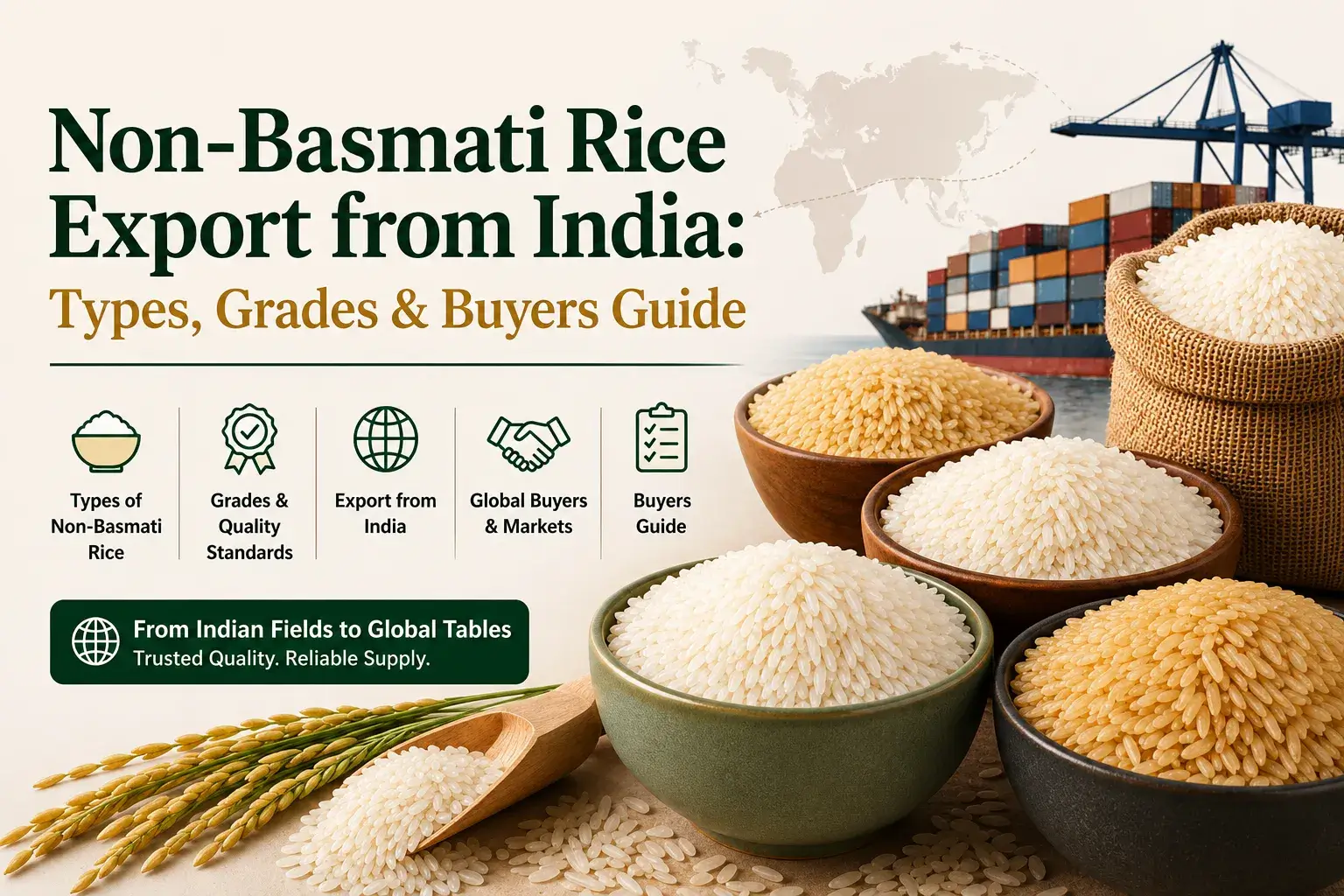
Non-Basmati Rice Export from India: Types, Grades & Buyer’s Guide
When most people think of Indian rice exports, they think of basmati. But non-basmati rice is actually the larger volume category — and for importers focused on price-sensitive markets, food aid procurement, institutional supply, or everyday retail, it represents some of the best sourcing value available anywhere in the world.
India is the world’s largest exporter of non-basmati rice, shipping tens of millions of metric tonnes annually to destinations across Africa, the Middle East, Southeast Asia, Europe, and the Americas. Varieties like PR11, IR64, Sugandha, and Sharbati are staples in hundreds of millions of households globally — they just receive less marketing attention than their fragrant basmati counterparts.
This guide is designed for importers, distributors, wholesale buyers, and procurement managers who need a practical, detailed reference for sourcing non-basmati rice from India. We cover all seven varieties supplied by Bansal FineFoods, how processing grades affect your buying decision, key quality specifications, and a market-to-variety matching guide so you can identify the right product for your customer base.
1. What Is Non-Basmati Rice — and Why Does It Matter for Exporters?
Non-basmati rice refers to all rice varieties grown in India that do not carry the “basmati” designation. While basmati is defined by its geographic origin (specific districts in Haryana, Punjab, UP) and its characteristic aroma compound (2-AP), non-basmati rice is a broad category encompassing dozens of varieties with different grain shapes, sizes, textures, and use cases.
Key distinctions for international buyers:
| Feature | Basmati Rice | Non-Basmati Rice |
|---|---|---|
| Grain length | 7.2–8.45 mm (extra-long) | 4.5–7.5 mm depending on variety |
| Aroma | Pronounced natural fragrance | Mild to none (Sugandha/Sharbati have mild aroma) |
| Price point | Premium — 30–70% above non-basmati | Competitive — volume-friendly pricing |
| Primary markets | GCC, UK, North America, premium retail | Africa, Asia, food aid, institutional, everyday retail |
| Annual India export | ~4–5 million MT | ~20+ million MT |
| Certifications | APEDA basmati quality norms apply | Standard food safety certifications |
| Best for | Restaurant/gourmet/premium channel | Volume supply, daily consumption, food processing |
For buyers targeting West Africa, East Africa, the Caribbean, South/Southeast Asia, or institutional procurement, non-basmati rice is almost always the primary product category. The margins are thinner per unit, but the volumes are significantly larger — and consistent year-round demand means predictable reorder cycles.
2. The Seven Non-Basmati Varieties from Bansal FineFoods
Bansal FineFoods exports seven non-basmati rice varieties, each suited to different markets and use cases. Here is a complete reference guide for buyers:
2.1 Sugandha Rice — The Aromatic Value Option
| Specification | Sugandha Creamy | Sugandha Golden | Sugandha Steam |
|---|---|---|---|
| Average Grain Length | 7.85 mm | 7.80 mm | 7.80 mm |
| Broken Grain | < 1% | < 1% | < 1% |
| Moisture | < 12% | < 12% | < 13% |
| Purity | 94% | 94% | 94% |
| Sortex | 100% Clean | 100% Clean | 100% Clean |
| Damaged/Discoloured | Nil | Nil | Nil |
Sugandha rice occupies a unique position in the non-basmati market — it has mild basmati-like aroma and relatively long grains (7.80–7.85 mm) that give it premium-adjacent appeal at a non-basmati price point. The name “Sugandha” literally means fragrance in Hindi, and buyers in price-sensitive markets who still want an aromatic rice experience often prefer it over plainer non-basmati options.
Best markets: CIS countries (Russia, Ukraine, Kazakhstan), price-sensitive Middle East buyers, North Africa, parts of Southeast Asia. Also popular as a lower-cost alternative to 1509 Basmati in markets where consumers want some aroma but full basmati pricing is a barrier.
Available grades: Sugandha Creamy Rice | Sugandha Golden Rice | Sugandha Steam Rice
2.2 Sharbati Rice — The Soft, Creamy Everyday Rice
| Specification | Sharbati Creamy | Sharbati Golden | Sharbati Steam |
|---|---|---|---|
| Average Grain Length | 7.10 mm | 7.05 mm | 7.05 mm |
| Broken Grain | < 1% | < 1% | < 1% |
| Moisture | < 12% | < 12% | < 13% |
| Purity | 94% | 94% | 94% |
| Sortex | 100% Clean | 100% Clean | 100% Clean |
| Damaged/Discoloured | Nil | Nil | Nil |
Sharbati rice is India’s premium everyday rice — a long-grain variety with a distinctive soft, buttery texture when cooked. The name comes from the Hindi word “Sharbat” (nectar), reflecting its slightly sweet taste profile. Grains measure 7.05–7.10 mm, placing it in the long-grain category without the full price premium of basmati.
Sharbati is a strong performer in markets where consumers want restaurant-quality texture at accessible pricing. Its soft, non-sticky cook makes it ideal for everyday rice dishes, biryanis on a budget, and hotel/catering operations that serve large volumes at multiple price points.
Best markets: GCC (budget and mid-range hospitality), MENA region, West Africa (urban markets), South Asian diaspora communities in UK and Canada seeking a basmati substitute.
Available grades: Sharbati Creamy Rice | Sharbati Golden Rice | Sharbati Steam Rice
2.3 PR11 Rice — India’s Highest-Volume Export Variety
| Specification | PR11 Creamy Sella | PR11 Golden Sella | PR11 Steam | PR11 Raw |
|---|---|---|---|---|
| Grain Type | Long grain | Long grain | Long grain | Long grain |
| Broken Grain | < 2% | < 2% | < 2% | < 2% |
| Moisture | < 12% | < 12% | < 13% | < 12% |
| Purity | 94% | 94% | 94% | 94% |
| Sortex | 100% Clean | 100% Clean | 100% Clean | 100% Clean |
| Shelf Life | 18–24 months | 24+ months | 18–24 months | 12–18 months |
PR11 (Punjab Rice 11) is India’s single most exported non-basmati rice variety — a long-grain white rice developed in Punjab that delivers consistent grain uniformity, high yield, and reliable quality at scale. If you have imported non-basmati rice from India in volume, you have almost certainly bought PR11 at some point.
Available in four processing grades — Creamy Sella, Golden Sella, Steam, and Raw — PR11 is the workhorse of India’s rice export industry. It feeds food aid programmes, fills supermarket shelves in West Africa, supplies hotel buffets across the Middle East, and stocks the mills of food processors on every continent.
| PR11 Buyer Profile | |
|---|---|
| Creamy Sella | General wholesale, supermarket retail, institutional kitchens |
| Golden Sella | West/East Africa, humid climates, long-distance shipping (24+ month shelf life) |
| Steam | Foodservice chains, hotel and restaurant supply, canteens |
| Raw | Rice millers, food processors, domestic market supply |
Available grades: PR11 Creamy Sella | PR11 Golden Sella | PR11 Steam Rice | PR11 Raw Rice
2.4 PR106 Rice — The Compact Grain for South Asian Diaspora
PR106 (Punjab Rice 106) is a medium-to-long grain rice variety with a shorter, slightly rounder profile than PR11. It is a staple in everyday cooking across India’s northern states and has strong demand in diaspora markets — particularly among South Asian communities in the UK, Canada, and the UAE who prefer a slightly stickier, more familiar grain texture for everyday meals, as opposed to the fluffy, separated grain of basmati or PR11.
Available in Creamy Sella grade, PR106 offers good shelf life and consistent quality. Its compact grain shape makes it popular in certain Asian cuisines that prefer a medium-grain texture, and it finds a niche in rice pudding, congee, and thick rice porridge applications globally.
Best markets: South Asian diaspora (UK, Canada, UAE), South Asia domestic and regional trade, specialty Asian grocers in Europe.
Available grades: PR106 Creamy Sella Rice
2.5 IR64 Rice — The Global Standard for Food Aid & Institutional Buyers
| Specification | IR64 Parboiled | IR64 White |
|---|---|---|
| Grain Type | Medium-long grain | Medium-long grain |
| Processing | Parboiled | Milled white |
| Moisture | < 14% | < 12% |
| Purity | 94% | 94% |
| Sortex | 100% Clean | 100% Clean |
| Broken Grain | < 5% (standard) | < 3% |
| Shelf Life | 24+ months | 18–24 months |
IR64 is an IRRI-developed semi-dwarf variety (International Rice Research Institute) that became one of the most widely grown and traded rice varieties in the world during the Green Revolution. Its consistent grain quality, high yield, and resilience in humid growing conditions made it the backbone of global food security programmes.
For importers, IR64 is the standard procurement rice for WFP, USAID, and government food aid programmes — its Parboiled grade carries 24+ month shelf life, high tolerance for humid storage, and meets international food safety specifications out of the box. IR64 White is the equivalent for retail and foodservice buyers who need a reliable, clean, medium-long grain white rice at competitive pricing.
| IR64 Parboiled — Key Facts for Aid/Institutional Buyers |
|---|
| Meets WFP (World Food Programme) technical specifications for parboiled rice |
| 24+ month shelf life from processing date under proper storage |
| Parboiling process drives nutrients into the grain — better nutritional retention than white rice |
| Highly resistant to insect infestation compared to white milled rice |
| Available in 25 kg, 50 kg PP bags and customised packaging on request |
Available grades: IR64 Parboiled Rice | IR64 White Rice
2.6 RH10 Rice — Value Pricing for High-Volume Markets
RH10 (Rohtak Hybrid 10) is a medium-long grain parboiled variety grown predominantly in Haryana. It offers consistent grain size, reliable 94% purity, and is available in Creamy Sella grade — making it an attractive value option for high-volume buyers who require a step down from premium non-basmati varieties in price while maintaining acceptable grain quality for bulk retail.
RH10 is not as widely known internationally as PR11 or IR64, but its competitive pricing makes it a preferred choice for volume-sensitive procurement — particularly in markets where the buyer is supplying to price-aware consumers in secondary cities or rural distribution networks across Africa and South Asia.
Best markets: West Africa (secondary tier retail), South/Southeast Asia, budget bulk wholesale programmes.
Available grades: RH10 Creamy Sella Rice
2.7 Round Rice — The Short-Grain Staple for Global Cuisines
Round Rice (also called short-grain or small-grain rice) is a compact, pearly-white grain variety with a slightly sticky texture when cooked. It is used across an exceptionally diverse range of global cuisines — from Indian khichdi and congee to European rice pudding, Middle Eastern stuffed dishes, and even as a risotto or sushi substitute at lower price points.
India’s Round White Rice carries clean grain, consistent size, and 94% purity. For importers, it is a niche but consistent product that fills specific buyer needs that long-grain varieties cannot — anywhere a slightly sticky, compact-grain texture is preferred, Round Rice delivers.
Best markets: Europe (rice pudding/dessert applications), Latin America, East Asia (as a budget substitute for medium-grain Asian rice), Middle East (stuffed vegetable dishes), South Asia.
Available grades: Round White Rice
3. Processing Grades Explained: What Every Non-Basmati Buyer Must Know
Unlike basmati — where naming is heavily regulated — non-basmati rice processing grades are somewhat standardised across the industry. Understanding them prevents costly mismatches between what you order and what your market expects.
| Processing Grade | Description | Shelf Life | Best For |
|---|---|---|---|
| Raw / White Milled | Milled without heat treatment. Pure white. Most delicate grain structure. Highest breakage risk in transit. | 12–18 months | Short supply chains, millers, processors, domestic distribution |
| Creamy Sella (Parboiled) | Partially parboiled before milling. Creamy off-white colour. Firmer grain, improved breakage resistance. Most widely exported grade globally. | 18–24 months | General retail, wholesale, Middle East, North Africa |
| Golden Sella (Parboiled) | Full parboiling. Distinctive golden-yellow colour. Longest shelf life, maximum breakage resistance. Retains more nutrients. | 24+ months | Sub-Saharan Africa, long-distance shipping, food aid, humid climate storage |
| Steam | Steamed under pressure without full parboiling. Retains white appearance with improved grain integrity. Fluffy cook. | 18–24 months | Foodservice, hotel & restaurant supply, canteens, large-volume kitchens |
| Key Buyer Rule: Match Grade to Climate |
|---|
| If your market has high humidity, long storage periods, or extended shipping routes, always specify Golden Sella. The full parboiling process makes the grain almost impervious to moisture ingress, insect damage, and grain breakage during long sea voyages. Creamy Sella and Steam grades are excellent for shorter supply chains with controlled storage. Raw should only be purchased when you have temperature and humidity-controlled warehousing and a fast time-to-market. |
4. Non-Basmati Rice Export Quality Specifications
Always request a full Certificate of Analysis (CoA) and product specification sheet before confirming any order. Below are the standard parameters for export-grade non-basmati rice from India — and what to watch for:
| Specification | Acceptable Range | Notes |
|---|---|---|
| Average Grain Length | 5.2–7.85 mm depending on variety | Shorter for Round/PR106, longer for Sugandha/Sharbati |
| Broken Grain % | < 1–2% for premium; < 5% for standard parboiled | Always confirm in the sales contract, not just spec sheet |
| Moisture Content | < 12% (Raw/Creamy/Golden); < 13–14% (Steam/Parboiled) | Moisture above 14% is a storage and mould risk |
| Purity | Minimum 94% | No foreign matter, stones, husk, or weed seeds |
| Sortex | 100% electronically sorted | Ensures colour uniformity and removes foreign grain |
| Damaged/Discoloured Grains | Nil | Discolouration indicates improper drying or storage issues |
| Black Grains | Nil | Presence indicates pest activity or fungal damage |
| Admixture (other varieties) | < 3% | Confirm variety purity, especially for Sugandha/Sharbati |
| Chalky Grains | < 3% for milled grades | High chalkiness indicates immature harvest or poor milling |
| Foreign Material | Nil | Zero tolerance for stones, sticks, insects, or plastic |
| ️ Red Flags in Non-Basmati Procurement |
|---|
| No sortex mention on the spec sheet — a basic quality step that any serious exporter performs |
| Moisture above 14% in any grade — risk of mould and spoilage, especially in Golden Sella |
| No APEDA registration — all legitimate Indian rice exporters must be APEDA registered |
| Unusually low broken grain % (e.g., 0%) claimed for large shipments — statistically implausible; request supporting CoA |
| “Sugandha” or “Sharbati” labelled rice without variety documentation — these terms are sometimes misused for generic non-basmati |
| No mention of sortex or cleaning process for IR64 Parboiled shipments — contamination risk in food aid grade rice is especially serious |
5. Market-to-Variety Matching Guide
Non-basmati rice is not one-size-fits-all. Matching the right variety and grade to your target market is as important as price negotiation. Use this guide as your starting reference:
| Your Market / Channel | Recommended Variety | Recommended Grade | Key Reason |
|---|---|---|---|
| West Africa (Nigeria, Ghana, etc.) | PR11 or IR64 | Golden Sella | Long shelf life, humidity resistance, price-competitive |
| East Africa (Kenya, Tanzania, etc.) | PR11 or RH10 | Golden Sella | Cost efficiency at volume, robust supply chain |
| North Africa (Egypt, Morocco) | Sugandha or Sharbati | Creamy Sella | Consumers prefer mild aroma and soft texture |
| Middle East (budget/mid-range) | Sharbati or Sugandha | Creamy or Steam | Soft cook quality, value vs basmati |
| GCC foodservice (hotel/catering) | Sharbati or PR11 | Steam | Fluffy texture, fast cooking, bulk volume |
| South/Southeast Asia | PR11 or PR106 | Creamy Sella or Raw | Familiar grain, competitive pricing |
| UK/Europe (South Asian diaspora) | Sharbati or PR106 | Creamy Sella | Basmati-like texture, lower price point |
| Food aid / WFP procurement | IR64 | Parboiled | Meets WFP specs, 24+ month shelf life, nutrient retention |
| Food processors / Millers | PR11 or IR64 | Raw | Unprocessed grain for re-milling and value-adding |
| European retail (short-grain uses) | Round Rice | White Milled | Distinct grain format for specific cuisine applications |
| CIS / Russia | Sugandha | Creamy Sella | Mild aroma preference, price-sensitive market |
| North America (institutional) | IR64 or PR11 | Golden Sella or Parboiled | Food safety compliance, shelf life, certifications |
6. India’s Non-Basmati Rice Export: Key Market Data
Understanding the macro context helps buyers anticipate supply fluctuations and negotiate with confidence.
| Data Point | Detail |
|---|---|
| India’s share of global rice trade | India is the world’s largest rice exporter — approximately 40–45% of global rice trade |
| Non-basmati export volume | 20+ million MT annually in recent years, dwarfing basmati volumes |
| Primary growing states | Punjab (PR11, PR106), Haryana (RH10, Sugandha, Sharbati), Andhra Pradesh (IR64), Uttar Pradesh |
| Key export destinations | West Africa, South/Southeast Asia, Middle East, EU, North America, Caribbean |
| Peak harvest / availability | Kharif crop: October–December. Rabi crop (some varieties): March–April |
| Export regulation | APEDA governs agricultural exports. Government minimum export price (MEP) may apply periodically |
| Packaging options | 5 kg, 10 kg, 25 kg, 50 kg PP bags; jute bags; bulk containers on request |
| Primary quality standard | FSSAI food safety norms; AGMARK specifications; importer-country standards (EU, FDA, etc.) |
| Shipping ports | Kandla, Mundra, Nhava Sheva (Mumbai), Kakinada — all handle large non-basmati rice volumes |
7. Certifications to Require from Your Non-Basmati Rice Supplier
The non-basmati segment is highly competitive, and quality varies enormously between suppliers. Certifications are your primary due-diligence tool before committing to a supplier relationship:
| Certification | Why It Matters |
|---|---|
| APEDA Registration | Mandatory for Indian agricultural exporters. Non-registered traders cannot legally export. |
| FSSAI License | India’s food safety authority. Confirms the processing facility meets food safety law. |
| ISO 9001:2015 | Quality management systems — ensures documented, repeatable processes. |
| HACCP | International food hazard control standard. Required by EU, GCC, and most North American buyers. |
| BRC Global Standard (Food) | Required for UK supermarket supply. Also widely respected by European retail buyers. |
| Halal Certification | Essential for GCC, MENA, Southeast Asia, and any market with significant Muslim consumer base. |
| FDA Registration (US) | Required for any shipments to the United States market. |
| Kosher Certification | Required for specific institutional buyers, Jewish community retail, and some European food manufacturers. |
| GMP (Good Manufacturing Practice) | Confirms hygiene and production standards in the processing plant. |
| 3-Star Export House (Ministry of Commerce) | Government-recognised status for high-volume, compliant Indian exporters. |
Bansal FineFoods holds all major certifications including APEDA, ISO, HACCP, BRC, Halal, FDA, FSSAI, GMP, FIEO, Kosher, and 3-Star Export House status — covering all 73 countries we actively supply.
8. Basmati vs Non-Basmati: How to Advise Your Customers
Many buyers ask us how to position non-basmati rice alongside or instead of basmati for their market. Here is a practical framework:
| When to recommend Non-Basmati over Basmati to your buyers: | |
|---|---|
| Price sensitivity is high | Non-basmati is 30–70% cheaper per MT. For everyday consumption markets, this is the primary driver. |
| High-volume daily consumption | Non-basmati suits markets where rice is a staple meal multiple times per day — East/West Africa, South Asia. |
| Food aid or institutional procurement | IR64 Parboiled meets all WFP and government programme specifications at a fraction of basmati cost. |
| Long shelf life needed | Golden Sella grades of PR11 and IR64 offer 24+ months — critical for remote distribution networks. |
| Specific grain texture required | Round Rice, PR106, and PR11 suit cuisines that prefer a compact, slightly sticky grain over the separate-grain texture of basmati. |
9. Why Source Non-Basmati Rice from Bansal FineFoods?
| What We Offer | Detail |
|---|---|
| 85+ years in agri-exports | Established in 1940 — one of India’s most experienced export houses |
| 3-Star Export House | Certified by Ministry of Commerce & Industry, Government of India |
| 73 countries served | Active buyer relationships across Africa, Middle East, Europe, CIS, Asia, Americas |
| 100,000 MT annual capacity | Two processing facilities in Karnal, Haryana — scalable for container to vessel orders |
| 7 non-basmati varieties | Sugandha, Sharbati, PR11, PR106, IR64, RH10, Round Rice — all processing grades available |
| German Bühler machinery | State-of-the-art multi-grain processing, automated sortex, export-grade hygiene control |
| 10+ international certifications | ISO, HACCP, BRC, Halal, FDA, FSSAI, GMP, FIEO, APEDA, Kosher — all current |
| Flexible packaging | 5 kg to 50 kg bags; PP, jute, custom branded options available |
| All incoterms available | FOB, CIF, CFR — Kandla, Mundra, Nhava Sheva |
10. Explore Each Non-Basmati Variety in Detail
Each variety has a dedicated product guide on our website with full specification tables for all available processing grades:
- Sugandha Rice — Aromatic Value Option (Creamy, Golden, Steam)
- Sharbati Rice — Soft & Creamy Everyday Rice (Creamy, Golden, Steam)
- PR11 Rice — India’s Highest-Volume Export Variety (Creamy Sella, Golden Sella, Steam, Raw)
- PR106 Rice — Compact Grain for South Asian Diaspora Markets (Creamy Sella)
- IR64 Rice — Global Standard for Food Aid & Institutional Buyers (Parboiled, White)
- RH10 Rice — Value Pricing for High-Volume Markets (Creamy Sella)
- Round Rice — Short-Grain Staple for Global Cuisines (White Milled)
Also explore our complete Basmati Rice Exporter and Supplier guide → if you source or compare both categories.
| Ready to Source Non-Basmati Rice from India? |
|---|
| Bansal FineFoods supplies all 7 non-basmati varieties to 73 countries from our 100,000 MT facility in Karnal, Haryana. Contact us for specifications, pricing, and samples.
info@bffpl.com +91-83989-10400 bansalfinefoods.com/contact-us MOQ from 1 container load │ FOB / CIF / CFR │ LC / TT / CAD payment terms |
Conclusion
Non-basmati rice from India is the backbone of global rice supply — higher volume, lower price, and available in a broader range of grain types and processing grades than basmati. Whether you are importing IR64 Parboiled for a food aid programme, PR11 Golden Sella for West African wholesale, Sugandha Creamy for CIS retail, or Round Rice for European specialty use, India’s non-basmati export supply chain is deep, reliable, and price-competitive.
The key to successful non-basmati sourcing is specificity: always name the variety, the processing grade, the broken grain %, and the moisture specification in your purchase order. Vague orders produce inconsistent results. The seven varieties covered in this guide each serve distinct markets — and using the right one for your channel is what separates a satisfied customer base from high return rates and quality complaints.
Bansal FineFoods has been supplying international buyers for over 85 years. If you are looking for a reliable, certified, and high-capacity non-basmati rice export partner in India, we would welcome the conversation.
About Bansal FineFoods
Bansal FineFoods is a 3-Star Export Trading House certified by the Ministry of Commerce & Industry, Government of India, exporting premium agri-products to 73 countries since 1940. Our product range includes basmati and non-basmati rice, pulses, spices, seeds, and nuts — all processed at our 350,000 sq ft facility in Karnal, Haryana using German Bühler machinery.
Website: bansalfinefoods.com | Email: info@bffpl.com | Phone: +91-83989-10400